
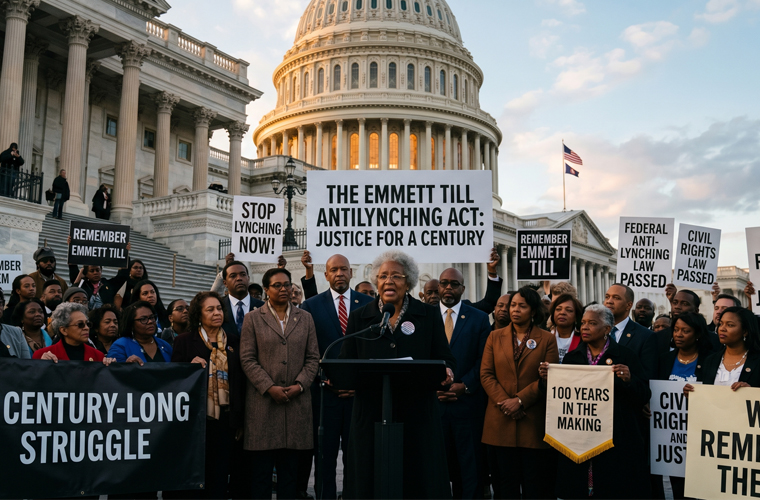
Lynching—the extrajudicial killing of individuals, often by mobs, typically as a form of racial terror—cast a long shadow over American history, particularly in the post-Reconstruction South. Between 1882 and 1968, records from the Tuskegee Institute document 4,743 lynchings, with approximately 3,446 victims (about 73%) being Black Americans. Other estimates, including those from the Equal Justice Initiative, suggest even higher numbers, with over 4,400 racial terror lynchings documented in the South alone between 1877 and 1950.
For more than 120 years, civil rights advocates, journalists, and lawmakers fought to make lynching a federal crime. Despite repeated failures—over 200 bills introduced in Congress—the persistence of activists culminated in the Emmett Till Antilynching Act of 2022, signed into law by President Joe Biden on March 29, 2022. This landmark legislation finally classified certain acts of lynching as federal hate crimes.
Historical Context: The Epidemic of Lynching
Lynching surged in the late 19th and early 20th centuries as a tool to enforce white supremacy, suppress Black economic and political progress, and maintain racial hierarchies after the end of slavery. Mobs often targeted Black men accused of minor offenses or fabricated crimes, with public spectacles involving torture, mutilation, and hanging. While some white individuals were also lynched, the vast majority of victims in the South were Black. States frequently failed to prosecute perpetrators, and local authorities sometimes participated or turned a blind eye. This impunity highlighted the need for federal intervention, as constitutional arguments about states’ rights often blocked national action.
Pioneering Voices: Ida B. Wells and Early Advocacy
One of the most powerful early crusaders was Ida B. Wells-Barnett (1862–1931), a journalist and activist. After the 1892 lynching of three friends in Memphis, Tennessee, Wells launched an investigative campaign, publishing Southern Horrors: Lynch Law in All Its Phases and A Red Record. She meticulously documented lynchings, debunking myths (such as the frequent rape allegations used as pretexts) and exposing economic and political motivations. Wells lectured across the U.S. and in Britain, petitioned presidents like William McKinley, and co-founded the NAACP. Her fearless work internationalized the issue and laid the groundwork for legislative efforts, though she faced threats, including the destruction of her newspaper office.
Early Legislative Efforts (1900s–1920s)
The first federal anti-lynching bill was introduced in 1900 by Rep. George Henry White (R-NC), the last Black member of Congress from the South in that era. It aimed to protect citizens from mob violence but died in committee. A major push came in 1918 with the Dyer Anti-Lynching Bill, introduced by Rep. Leonidas C. Dyer (R-MO), spurred by events like the East St. Louis riots. Supported by the NAACP, the bill passed the House in 1922 but was filibustered in the Senate by Southern Democrats. This pattern—House passage blocked by Senate filibuster—repeated for decades. Subsequent efforts, such as the Costigan-Wagner Bill in the 1930s, gained traction amid the New Deal era and public outrage but similarly failed due to Southern opposition and debates over federal authority versus states’ rights.
Decades of Failure and Continued Advocacy
Presidents from both parties, including Harry Truman and Dwight Eisenhower, supported anti-lynching measures, but Southern senators wielded the filibuster effectively. The NAACP and other groups kept the issue alive, documenting atrocities and pushing for change. In 2005, the Senate issued a formal apology for its historical inaction on anti-lynching legislation. High-profile cases kept the issue in the public eye, including the 1955 murder of 14-year-old Emmett Till in Mississippi. Till’s mother, Mamie Till-Mobley, insisted on an open-casket funeral, exposing the brutality to the world and galvanizing the Civil Rights Movement.
Victory at Last: The Emmett Till Antilynching Act
In 2018, Sens. Cory Booker (D-NJ) and Tim Scott (R-SC), along with Rep. Bobby Rush (D-IL), reintroduced the legislation. It gained bipartisan momentum, especially after the 2020 murder of George Floyd. The bill passed the House overwhelmingly (422–3) in 2022 and the Senate by unanimous consent. On March 29, 2022, President Biden signed the Emmett Till Antilynching Act into law (Public Law 117-107).
Key Provisions:
- It amends federal hate crime law (18 U.S.C. § 249) to explicitly address lynching.
- Defines lynching in the context of conspiracy to commit a hate crime resulting in death or serious bodily injury (including kidnapping or aggravated sexual abuse).
- Imposes penalties of up to 30 years in prison, fines, or both.
This marked the first time lynching was explicitly a federal hate crime, providing tools for federal prosecution when states fail.
Significance and Legacy
The Act represents a long-overdue acknowledgment of historical failures and a step toward accountability. While lynching as historically practiced has largely ended, the law addresses modern forms of mob violence motivated by bias. It honors countless victims, from unknown individuals to icons like Emmett Till, and the tireless advocates who refused to let the issue die. The journey from the first bill in 1900 to 2022 underscores the challenges of overcoming entrenched interests and the power of persistent advocacy, journalism, and coalition-building. As America continues confronting its past, the Emmett Till Antilynching Act stands as a testament to the possibility of progress, however delayed.