
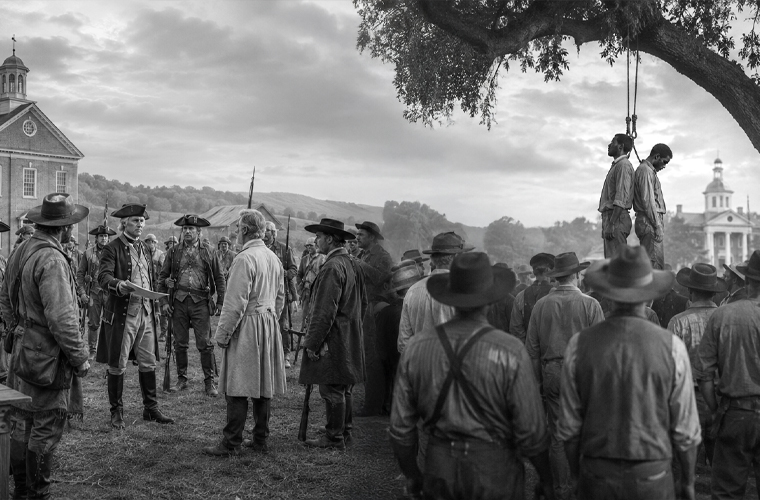
The term “Lynch Law” (later “lynching”) occupies a dark and complex place in American history. Its origins lie in the patriotic zeal and wartime exigencies of the American Revolution. Yet, it became synonymous with one of the nation’s most shameful chapters: the systematic use of extrajudicial mob violence, particularly against African Americans in the post-Civil War South.
Origins: Charles Lynch and the American Revolution
The phrase “Lynch’s Law” is most commonly traced to Colonel Charles Lynch (1736–1796), a Virginia planter, justice of the peace, and Patriot militia officer from Bedford County. During the Revolutionary War, particularly in 1780, Lynch and fellow officers faced threats from Loyalist (Tory) sympathizers who sought to undermine the Patriot cause—most critically by targeting lead mines essential for manufacturing ammunition.
With formal courts distant and the frontier vulnerable, Lynch and his associates conducted summary “drumhead” trials. Suspected Tories were rounded up, given quick proceedings, and subjected to corporal punishment—most commonly 39 lashes with a whip, often administered while tied to a walnut tree. Other penalties included property seizure, forced oaths of allegiance to the American cause, and conscription into the Continental Army. In at least some cases, enslaved Black laborers at the mines accused of aiding Tories received similar treatment.
In a letter dated May 11, 1782, Charles Lynch himself used the term “Lynch’s Law” while addressing disciplinary issues at the lead mines. This appears to be the earliest documented use of the phrase. Governor Thomas Jefferson supported strong measures against internal threats, and in 1782, the Virginia General Assembly passed an act of indemnity that retroactively shielded Lynch and his colleagues from legal repercussions for their wartime actions.
At the time, “Lynch’s Law” described rough, extralegal frontier justice born of necessity during a war for independence. Lynch’s actions were viewed by many Patriots as pragmatic and essential for securing the Revolution. Historic markers in modern-day Campbell and Bedford Counties, Virginia, still commemorate the site of these proceedings.
Evolution of the Term
After the Revolution, the term spread and its meaning began to shift. By the early 19th century, “lynch law” was used more broadly to describe any form of extrajudicial punishment—often vigilante action in areas with weak formal legal systems, such as the expanding Western frontier. It still typically involved whipping or banishment rather than execution. By the mid-19th century, the word “lynching” increasingly referred to mob killings, frequently by hanging. The practice appeared in various contexts: regulating behavior on the frontier, enforcing community norms, and, most infamously, as a tool of racial and political control.
Lynching in the South: A Tool of Racial Terror
Following the Civil War and Reconstruction, lynching in the South transformed into a systematic instrument of white supremacy. Between 1882 and 1968, documented lynchings exceeded 4,700, with the overwhelming majority targeting Black Americans, particularly in Southern states like Mississippi, Georgia, and Texas. These acts were rarely spontaneous. Mobs—sometimes numbering in the thousands and including local officials or community leaders—publicly tortured, mutilated, burned, and hanged victims. Lynchings served multiple purposes:
- Terror and Social Control: To intimidate Black communities, suppress voting rights, economic independence, and social advancement during and after Reconstruction.
- Enforcing Racial Hierarchy: Punishing perceived violations of Jim Crow norms, such as alleged crimes against white people or “insolence.”
- Bypassing Legal Systems: Mobs often seized victims from jails, acting when courts were deemed too lenient or when the goal was spectacle rather than justice.
Unlike Charles Lynch’s Revolutionary-era punishments, which were tied to wartime loyalty and rarely fatal, Southern lynchings were frequently sadistic public spectacles designed to reinforce white dominance. Organizations like the Ku Klux Klan and “red shirt” groups used violence alongside political intimidation. Anti-lynching crusaders such as Ida B. Wells documented these horrors, highlighting their barbarity and the complicity of local authorities.
Legacy
Charles Lynch was a product of his time—a zealous Patriot who used harsh methods to defend the fledgling United States. He could not have foreseen that his name would become attached to a vastly different and far more lethal form of violence a century later. The evolution of “Lynch Law” illustrates how the concept of popular justice outside formal law can be repurposed for darker ends.
Today, the term “lynching” evokes images of racial terror and injustice. Memorials such as the National Memorial for Peace and Justice in Montgomery, Alabama, honor victims and confront this painful history. While the original Revolutionary context was defensive and limited, the later perversion of the term stands as a reminder of the dangers of mob rule and the fragility of due process. The story of Lynch Law is ultimately one of transformation: from wartime necessity on the Virginia frontier to a symbol of America’s long struggle with racial violence and the rule of law.