
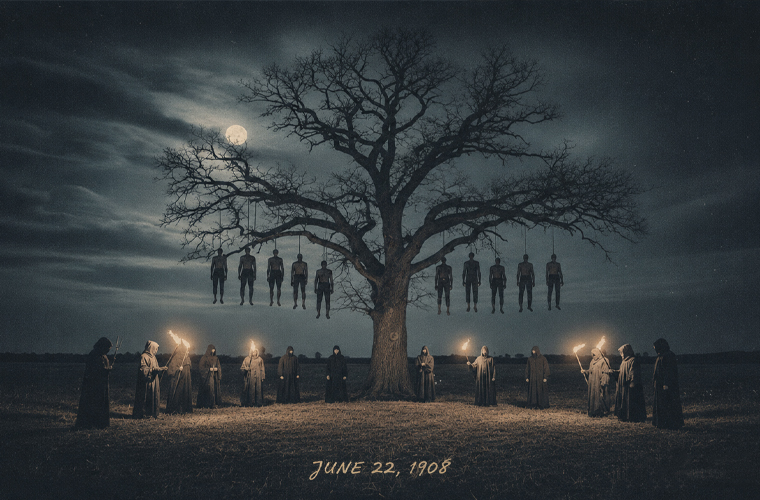
On June 22, 1908, a white mob in Sabine County, Texas, carried out one of the most brutal episodes of racial violence in the state’s history, lynching nine Black men within a single 24-hour period. The terror began the previous evening, June 21, when an unknown assailant shot and killed a white farmer in his home. In the racially charged atmosphere of the post-Reconstruction South, where deep-seated hostility toward Black communities was pervasive, suspicion immediately and predictably turned toward Black residents—even in the absence of any credible evidence. Accusations against Black individuals were seldom subjected to thorough investigation or due process; instead, they frequently served as pretexts for mob violence.
At the time, six Black men—Jerry Evans, William Johnson, William Manuel, Moses Spellman, Cleveland Williams, and Frank Williams—were already being held in the local jail. They had been arrested in connection with an entirely separate shooting of another white man and were not suspected in the farmer’s death. Early on the morning of June 22, a mob of approximately 200 white men stormed the jail, overpowering law enforcement and forcibly removing the six prisoners from custody. Five of the men were taken outside and hanged from a tree near the jail. The sixth, Cleveland Williams, was shot in the back while attempting to flee.
The violence did not end there. Later that night, marauding white men continued their rampage. They shot and killed a Black man named Bill McCoy near the white farmer’s home. Two other unidentified Black men were also shot to death, and their bodies were dumped into a nearby creek. In a further act of collective punishment against the Black community, a Black church and a schoolhouse were burned to the ground.
This episode exemplified the broader pattern of racial terror that gripped the American South in the late 19th and early 20th centuries. Lynchings were frequently triggered by mere allegations of Black-on-white violence—especially murder—regardless of evidence. White mobs routinely bypassed the judicial system, dragging Black individuals from jails, courtrooms, and police custody. Law enforcement officers, whose duty was to protect those in their charge, often stood by or even participated in the violence. In Sabine County, as in countless other cases, authorities failed to intervene.
Racial terror was not limited to punishing specific individuals; it was designed to reinforce white supremacy by instilling widespread fear throughout Black communities. Lynch mobs often expanded their targets beyond the original accused, attacking any Black people they encountered. This arbitrary and unpredictable brutality served as a tool of social control, demonstrating that Black lives held little value and that white mobs could act as judge, jury, and executioner with impunity. Lynchings frequently went unpunished, and the legal system offered scant protection to Black citizens.
The nine Black men killed in Sabine County on June 22, 1908, were among more than 640 documented victims of lynching in Texas between 1865 and 1950. Their deaths stand as a stark reminder of the systematic racial violence that defined much of the Jim Crow era.