
The Exploitation of Wet Nursing in the Antebellum South: A Gendered and Racialized Practice
Wet nursing, the practice of feeding an infant with breast milk from a woman other than the child’s mother, has long been a site of complex social dynamics, shaped by intersecting factors of gender, race, class, and power. In the antebellum South, wet nursing emerged as a particularly exploitative practice within the institution of slavery, where enslaved women were compelled to nurse the children of their enslavers. This practice not only commodified the physical labor of enslaved women but also appropriated their reproductive capacities, creating a deeply gendered and racialized form of exploitation.
This article examines wet nursing in the antebellum South by situating it along a spectrum of gendered labor. At one end of this spectrum lies enforced wet nursing under slavery, while at the other end exist informal networks of shared breastfeeding among women. Between these extremes is the paid employment of professional wet nurses, a practice often influenced by class hierarchies. By exploring these variations, we can better understand the historical and social implications of wet nursing as a practice that intersects with ideologies of race, ethnicity, and class.

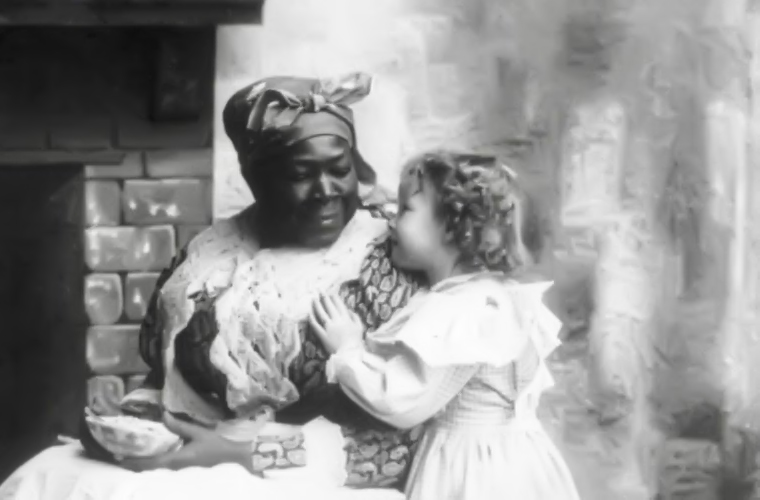
In the context of slavery, wet nursing was not merely an act of caregiving; it was a form of labor imposed on enslaved women that intertwined with their roles as both workers and reproducers. Enslaved women who were compelled to nurse white infants were often lactating mothers themselves, having recently given birth to their children. This exploitation extended beyond physical labor to the emotional and biological realms, as it disrupted enslaved women’s ability to care for their infants. The image of an enslaved woman nursing a white child epitomizes the racial and gendered power dynamics of the time: her body was co-opted to sustain the offspring of her oppressors while her own child’s well-being was neglected.
For enslaved women, wet nursing represented a profound violation of their autonomy and motherhood. Their milk, a symbol of maternal care and nourishment, was appropriated to serve the interests of white slaveholding families. This practice reinforced the dehumanization of enslaved women, reducing them to mere instruments for the benefit of others. Moreover, it underscored the systemic nature of slavery, where every aspect of an enslaved person’s life—labor, reproduction, and even bodily functions—was subjected to control and exploitation.
While enslaved women bore the brunt of this exploitation, slaveholding women played a pivotal role in perpetuating the practice. For many white women in the antebellum South, employing an enslaved wet nurse was a marker of social status and privilege. By delegating the responsibilities of breastfeeding to enslaved women, they could avoid the physical demands of nursing and focus on other pursuits deemed more appropriate for their social class. This dynamic further entrenched racial hierarchies, as enslaved women’s labor enabled white women to maintain their privileged lifestyles.
However, the relationship between enslaved wet nurses and slaveholding women was not solely defined by exploitation. Wet nursing created a physical intimacy between women across racial lines, as enslaved women held and nourished white infants. This intimacy, however, did not translate into equality or solidarity. Instead, it often reinforced racial boundaries, as slaveholding women exercised authority over the bodies and labor of enslaved women. In rare instances, white women also wet-nursed enslaved infants, but these acts were exceptions rather than the norm and were often motivated by specific circumstances rather than altruism.
While enforced wet nursing under slavery represents one extreme of exploitation, other forms of wet nursing existed in the antebellum South that were shaped by different social dynamics. Wealthier families sometimes employed professional wet nurses—women who were paid for their services. These arrangements were influenced by class hierarchies, as wet nurses were typically women from lower socioeconomic backgrounds. Although these relationships were less coercive than those involving enslaved women, they still reflected unequal power dynamics and economic disparities.
At the opposite end of the spectrum were informal networks of shared breastfeeding among women. In these arrangements, mothers supported one another by sharing breast milk, often within close-knit communities or among relatives. While evidence of such practices in the antebellum South is limited, they likely existed as acts of mutual aid and solidarity. These informal networks stand in stark contrast to the exploitative practices associated with slavery and highlight the potential for breastfeeding to foster communal bonds rather than reinforce hierarchies.
The historical patterns of wet nursing in the antebellum South have left a lasting legacy that continues to shape perceptions of breastfeeding today. The exploitative nature of wet nursing under slavery has contributed to contemporary discomfort with the practice, particularly within medical and social contexts. This discomfort is compounded by broader cultural attitudes toward breastfeeding, which are often influenced by race, class, and gender.
At the same time, informal networks of shared breastfeeding—though historically underexplored—offer an alternative narrative that emphasizes cooperation and care among women. Recognizing these practices can help challenge dominant narratives that frame breastfeeding solely within hierarchical or exploitative frameworks.
Wet nursing in the antebellum South exemplifies the intersection of gendered labor, racial exploitation, and class inequality. Under slavery, it represented a particularly egregious form of commodification that appropriated both the physical labor and reproductive capacities of enslaved women. While other forms of wet nursing existed along a spectrum—from paid employment to informal networks—each was shaped by broader social structures that reflected power imbalances.
By examining wet nursing within its historical context, we gain insight into how race, class, and gender have shaped practices of infant feeding across time and space. This understanding not only illuminates the experiences of women in the past but also challenges us to critically examine contemporary attitudes toward breastfeeding and maternal care. Wet nursing remains a powerful lens through which to explore enduring questions about inequality, motherhood, and the intersections of labor and reproduction.