
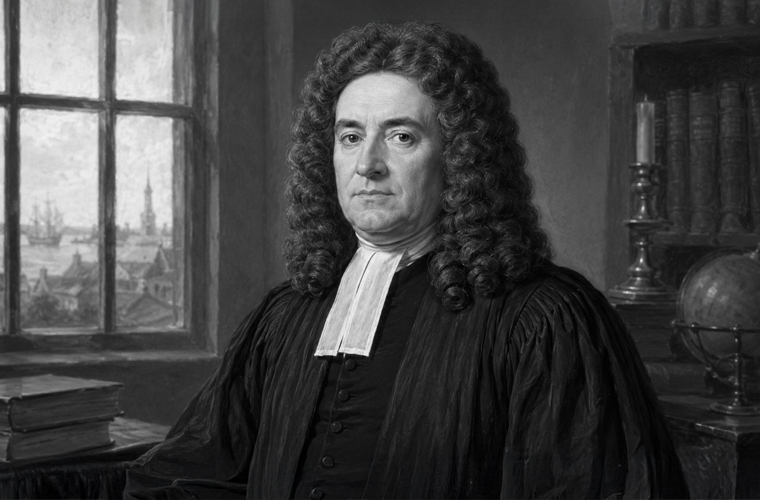
Cotton Mather (February 12, 1663 – February 13/15, 1728) was a prominent Puritan minister, prolific author, and one of the most influential intellectual figures in colonial New England. Born in Boston, Massachusetts Bay Colony, Mather came from a distinguished Puritan lineage. He was the son of Increase Mather and Maria Cotton, and grandson of John Cotton and Richard Mather. A child prodigy, he entered Harvard at age 12, earned his degrees, overcame a speech impediment, and was ordained in 1685 as a colleague to his father at Boston’s North Church.
Ministry and Public Life
Mather served as a minister for over four decades, emphasizing personal piety, prayer, and moral reform. He played a role in colonial politics, including the 1689 revolt against Governor Edmund Andros. He blended fervent religious mysticism with scientific interests, notably advocating for smallpox inoculation (variolation) during the 1721 Boston epidemic after learning of the practice from an enslaved African in his household. He was elected a fellow of the Royal Society of London.
Slave Ownership and Views on Slavery
Like many wealthy Puritan ministers of his time, Cotton Mather was a slave owner. Over his lifetime, he owned at least three (and likely more) enslaved people who performed domestic labor in his Boston household.
- He once purchased a Spanish Indian servant and gave him to his father.
- In 1706, his congregation gifted him a young West African man named Onesimus. Mather taught him to read and write, worked toward his Christian conversion, and described him as intelligent. Onesimus informed Mather about the African practice of smallpox variolation, which Mather later promoted widely. Mather eventually granted Onesimus conditional freedom in exchange for payment (toward buying a replacement slave) while settling debts.
- He also owned other enslaved individuals, including one named Obadiah.
Mather theologically defended slavery in works such as A Good Master Well Served (1696) and The Negro Christianized (1706). He argued that slave owners should educate and convert enslaved people to Christianity, treat them with justice and kindness, and recognize their spiritual equality (“of one blood”), while making clear that conversion did not grant legal freedom or alter their status as property. He viewed Christianizing enslaved Africans as a divine opportunity that improved both their souls and their value as obedient servants. He never advocated for abolition and saw slavery as consistent with biblical teaching and divine providence.
Writings and Major Works
Mather authored over 400 works. His most famous is Magnalia Christi Americana (1702), an ecclesiastical history of New England. He also wrote *Wonders of the Invisible World* (1693), defending the Salem witch trials.
Role in the Salem Witch Trials
Though not a judge, Mather advised on spectral evidence and wrote in defense of the trials’ proceedings. He is often seen as a moderating voice who urged caution, yet his writings helped legitimize the events at the time.
Personal Life and Legacy
Mather married three times and fathered 15 children, most of whom predeceased him. He died in Boston in 1728. Mather embodies the complexities and contradictions of late Puritan New England: deep piety and intellectual curiosity alongside participation in and justification of slavery. He was a product of his era—advancing ideas like inoculation (in part thanks to Onesimus) while upholding the social and economic institutions of colonial society, including slave ownership. Modern scholarship views him as a nuanced figure central to early American religious, literary, and intellectual history, though his involvement with slavery remains a significant and troubling aspect of his legacy.