
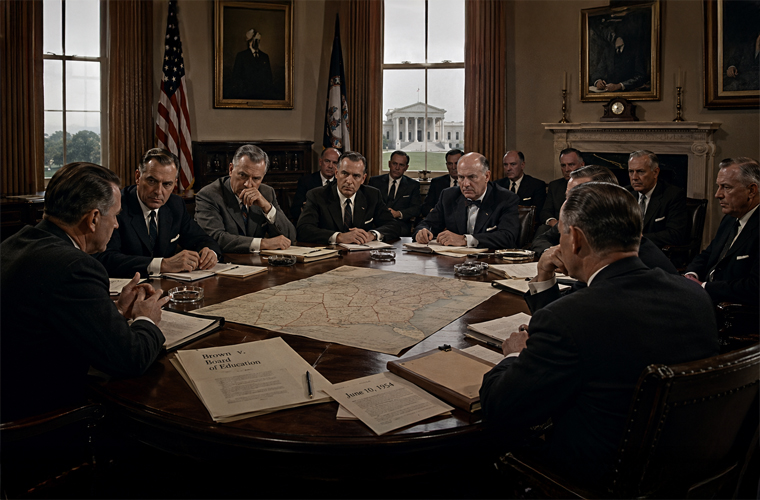
On June 10, 1954, governors and state representatives from 12 Southern states gathered in Richmond, Virginia, to coordinate a unified response to the U.S. Supreme Court’s landmark ruling in Brown v. Board of Education. Issued just weeks earlier, the decision declared racial segregation in public schools unconstitutional, overturning laws across the South that had mandated separate educational facilities for Black and white students.
Virginia Governor Thomas Stanley convened the meeting to explore possible courses of action. Governors from Georgia, South Carolina, and Mississippi had already taken hardline public positions, signaling their willingness to shut down public school systems entirely rather than integrate them. Leaders in Louisiana, North Carolina, and Virginia adopted somewhat more measured tones in public statements but made clear they were actively seeking legal avenues to delay or prevent desegregation.
Following more than six hours of discussion, delegates from nine of the 12 states committed to organized resistance against the Supreme Court’s order. Maryland, West Virginia, and Kentucky declined to join the pledge—states that also had relatively small Black populations at the time.
The strong declarations of defiance from top Southern officials emboldened white communities across the region to launch what became known as “massive resistance.” This movement involved legal maneuvers, economic pressure, threats, and, in many cases, outright violence. The campaign lasted for years and extended well beyond the South. While public officials had warned that integration posed an existential threat to Southern society and stoked widespread fears, many later distanced themselves from the resulting unrest. “No one had any thought of doing anything wrong,” Virginia Governor Stanley remarked after the meeting. “Everyone is just trying to find a solution to what they consider a major problem.”
The Brown decision marked the beginning of a profound transformation in American race relations, but it also triggered a broad, organized backlash. A majority of white Southerners—and many white Americans elsewhere—supported continued segregation and opposed rapid integration.
The resistance strategy discussed in Richmond proved largely effective in the short term. As late as 1960, desegregation remained extremely limited:
- In Arkansas, only 98 of 104,000 Black students attended desegregated schools.
- In North Carolina, just 34 of 302,000.
- In Tennessee, 169 of 146,000.
- In Virginia, 103 of 203,000.
In the five Deep South states, none of the roughly 1.4 million Black schoolchildren attended integrated schools until the fall of 1960. By the 1964–65 school year, fewer than 3 percent of Black children in the South were enrolled in schools with white students. In Alabama, Arkansas, Georgia, Mississippi, and South Carolina, the figure remained well below 1 percent.
The Richmond meeting illustrated the depth of institutional opposition to the civil rights changes beginning to sweep the nation and set the stage for more than a decade of conflict over school integration.