
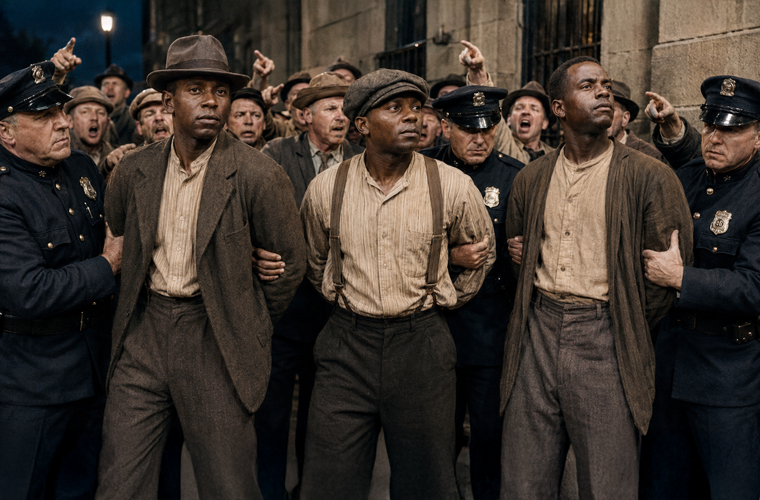
On the evening of June 15, 1920, a white mob in Duluth, Minnesota, lynched three young Black men—Elias Clayton, Elmer Jackson, and Isaac McGhie—all in their early twenties. The brutal killings shocked the nation because they occurred not in the Deep South, where lynchings were tragically common, but in a Northern industrial city long regarded as relatively progressive.
The three men were temporary workers with a traveling circus that had arrived in Duluth. On the day of the incident, two white teenagers falsely accused six Black circus workers—including Clayton, Jackson, and McGhie—of attacking them and raping a local white woman. Local newspapers quickly published sensational accounts of the alleged crime, fanning public outrage. False rumors spread rapidly through the city that the woman had died from her injuries, even though no evidence of any assault existed. Police arrested all six men and placed them in the city jail for their “protection.”
At the time, Duluth’s Black population was small but growing. Out of approximately 98,000 residents, only 495 were Black. Many had been recruited from the South during the early years of the Great Migration to fill labor needs at the United States Steel plant in nearby Morgan Park. Others worked in service roles as janitors, hotel servers, railroad porters, and factory assemblers. Despite their contributions, Black residents faced systemic discrimination. They were paid lower wages than their white counterparts, confined to substandard and overcrowded housing in segregated neighborhoods, and routinely excluded from many areas of public life. White workers, fearing economic competition, often harbored deep resentment toward Black migrants, creating a volatile racial atmosphere similar to that in other Northern cities experiencing demographic shifts.
Fueled by these tensions and the inflammatory reports, a massive mob of between 5,000 and 10,000 white Duluth residents gathered outside the jail that night. They overwhelmed local authorities, broke into the facility, and seized three of the prisoners: Elias Clayton, Elmer Jackson, and Isaac McGhie. The men were dragged through the streets, beaten, and hanged from a light pole at the corner of First Street and Second Avenue in the heart of downtown Duluth. The other three accused men remained in custody and were later protected when the Minnesota National Guard arrived the next morning to restore order. Remarkably, despite the scale of the mob and the public nature of the crime, no one was ever arrested or convicted for the lynchings.
The Duluth lynching stood as a stark reminder that racial terror was not confined to the South. It highlighted how quickly mob violence could erupt even in communities with small Black populations when fueled by rumor, fear, and racism.
Commemorating the Victims
For more than 80 years, the event was largely omitted from Duluth’s public memory. That began to change in the early 21st century. On October 10, 2003, a memorial was dedicated near the site of the lynching to honor Clayton, Jackson, and McGhie. The Clayton Jackson McGhie Memorial serves as a permanent public acknowledgment of the injustice.
Community efforts have continued in recent years. In September 2017, residents worked with staff from the Equal Justice Initiative (EJI) to collect soil from the site of the lynching as part of EJI’s National Memorial for Peace and Justice in Montgomery, Alabama. Then, in October 2020, the Clayton Jackson McGhie Memorial, the Duluth Chapter of the NAACP, city officials, and community members partnered with EJI to unveil a new historical marker at the site. These initiatives are part of a broader movement to document, remember, and confront Duluth’s—and America’s—history of racial terror lynchings.
Today, the memorial and marker stand as solemn reminders of the three young men whose lives were violently taken and of the enduring work required to address historical injustice and promote racial understanding in the community.