
The Historic Airlift of Ethiopian Jews to Israel
In the 1970s, the Israeli government recognized the urgent need to facilitate the immigration of Ethiopian Jews, known as Beta Israel, who faced severe restrictions under Ethiopia’s government, which prohibited emigration to Israel. The Beta Israel community, living in dire conditions and facing persecution, sought refuge in Israel, their ancestral homeland. To address this humanitarian crisis, the Israel Defense Forces (IDF) initiated a series of covert and large-scale airlift operations starting in 1984, culminating in the monumental Operation Solomon in 1991.
By the early 1990s, Ethiopia was grappling with political instability, famine, and an intensifying civil war. The weakening Ethiopian government faced imminent collapse as Eritrean and Tigrayan rebel forces advanced. This volatile situation placed the Beta Israel community in grave danger, with famine exacerbating their plight and the threat of violence looming. On March 7, 1991, Uri Lubrani, an Israeli diplomat, issued a critical report highlighting the deteriorating military situation in Ethiopia. He urged the Israeli government to devise an emergency plan to protect and evacuate approximately 18,000 Ethiopian Jews.
Planning and Preparation
Operation Solomon was a meticulously planned mission driven by both humanitarian and Zionist imperatives. The operation required significant financial and logistical coordination. The Israeli government allocated $35 million to negotiate with the Ethiopian authorities, securing permission for the Beta Israel to leave the country. This diplomatic breakthrough was critical, as Ethiopia’s restrictive policies had previously blocked such large-scale emigration.
The Israel Air Force (IAF) played a central role in executing the airlift. The operation involved six El Al Boeing 707s and 18 Lockheed C-130 Hercules aircraft, capable of transporting the entire Beta Israel community of approximately 18,000 people. The mission was structured into two phases: a three-hour flight from Israel to Addis Ababa using Boeing 707s, followed by a five-hour return journey to Israel using Hercules aircraft. To maximize capacity, the seats in the Hercules planes were removed, allowing each aircraft to carry up to 1,200 passengers—far exceeding the initial estimate of 760, as many Ethiopian Jews were malnourished and weighed less than anticipated.
The ground operation was equally complex. The plan involved gathering the Beta Israel community at the Israeli embassy in Addis Ababa, where they were organized into groups and transported to the airport in specially designated buses. An Israeli soldier of Ethiopian descent escorted each bus to ensure clear communication and cultural sensitivity. Medical teams, including doctors and paramedics, were on hand to provide care, as many evacuees were in poor health due to famine and hardship.
Execution of Operation Solomon
On May 24, 1991, Operation Solomon commenced with the first Hercules landing in Addis Ababa at approximately 10:00 AM. The crew immediately established a command center to coordinate the airlift. The operation faced immediate challenges: one IAF officer recalled that the control tower in northern Ethiopia was unresponsive, as the city had been overtaken by rebels hours earlier. Despite these obstacles, the Addis Ababa airport remained operational, with ground services functioning efficiently despite heavy air traffic. The first Boeing 707 took off at noon, followed by a steady stream of aircraft, with up to 27 planes in the air simultaneously at the operation’s peak.
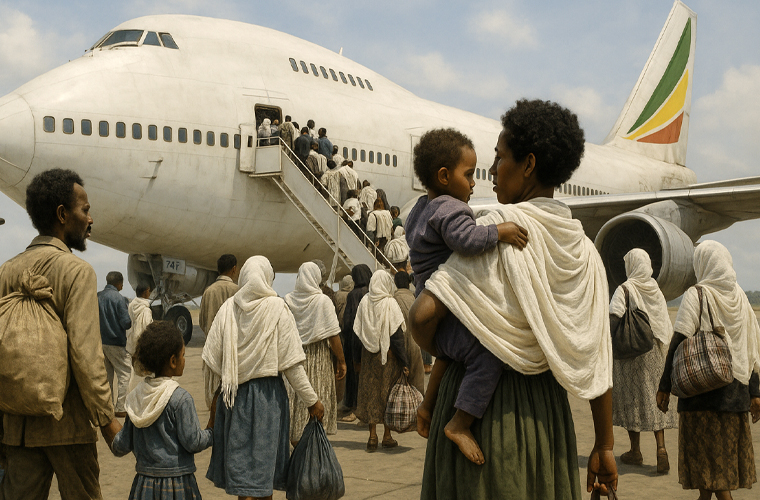
The airlift was a logistical triumph. In just under 36 hours, the IAF completed 41 sorties, transporting 14,325 Ethiopian Jews to Israel. The operation set a world record for the number of passengers carried on a single flight, with one Boeing 747 carrying 1,088 people. The evacuees, many of whom had fled their homes with only the clothes on their backs, were organized into groups of 200 for boarding. Medical personnel provided continuous support, addressing the health needs of malnourished and exhausted passengers.
Arrival in Israel
At 5:00 PM on May 24, 1991, the first plane touched down in Tel Aviv. The evacuees, weary and apprehensive, disembarked to a warm welcome from Israeli officials, including Prime Minister Yitzhak Shamir. The emotional weight of the moment was palpable: children clung to their mothers, and one young man carried his elderly father on his shoulders, both pausing to kiss the ground upon arrival. Anat Tal-Shir, a reporter for Yediot Aharonot, described the scene: “Everyone looked tired and scared… They fled their country with nothing but the clothes they were wearing.” The arrival marked the culmination of a historic effort to reunite the Beta Israel with their homeland. For many, it was their first encounter with modern infrastructure and a new chapter in a land they had dreamed of reaching.
Reflections and Legacy
Operation Solomon was a defining moment in Israel’s history, embodying the nation’s commitment to providing a haven for Jews worldwide. IAF Commander Major General Avihu Ben-Nun reflected, “Operation Solomon truly represents what Zionism is. It demonstrates the purpose for the State of Israel: to provide a home and shelter for Jews around the world who have suffered and were persecuted merely for being Jewish.” Lieutenant General Benny Gantz, who led the ground operation as commander of the Shaldag Unit, later shared his perspective: “Only during the mission did I get a sense of how meaningful it was to be part of this crucial event. It’s a turning point in my service, encompassing both my Zionist values and the meaning of our existence in this country.” Operation Solomon not only saved thousands of lives but also strengthened the cultural and social fabric of Israel by integrating the Beta Israel community. The operation remains a testament to Israel’s logistical prowess, diplomatic ingenuity, and unwavering commitment to its founding principles.