
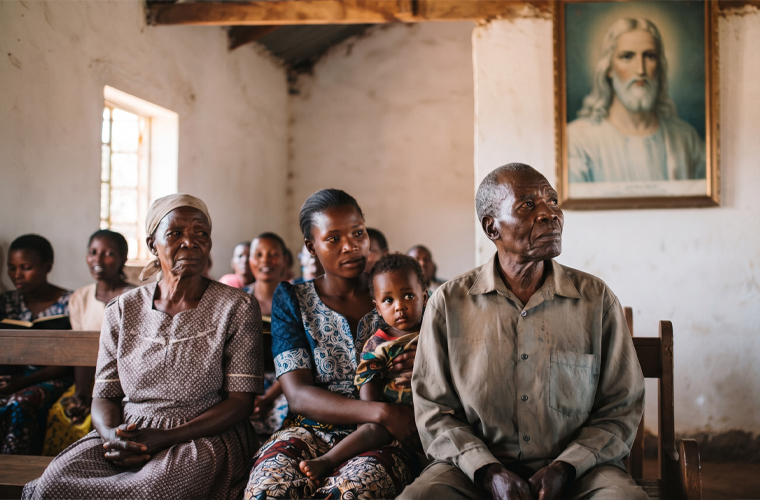
The most profound and persistent disaster of European colonialism in Africa may not be the redrawn borders, the extracted resources, or the political instability it left behind. Rather, it is the spiritual and visual transformation of divinity itself — the imposition of a distinctly Eurocentric image of God that continues to shape how millions of Africans perceive the divine and, by extension, themselves.
Clarifying the Stand: “There Is No (White) God”
We have said many times that there is no God — but each time we are quoted out of context and misunderstood. Our position is not a blanket denial of the Creator, but a vehement rejection of the colonial brand of religion enforced by the gun. The missionaries and colonial masters laid waste to Africa’s indigenous images and ideologies of God, labeling them evil and pagan. In their place, they substituted a new image: a white God who looks like the European man.
If the only God presented to the world is this European-looking deity, then there is no God. This is the God we reject in our teachings. Note that this is distinct from discussions about the historical Yeshua (Jesus), who was never European — a topic for another day.
Even though some African Christians deny it publicly, when they kneel to pray and close their eyes, what many truly visualize is a white God in the sky. Pastors and priests often return from “visions” describing a white God in shining white garments. This is not a coincidence. It is the result of decades of mental and psychological programming — from childhood through adulthood — delivered through parents, schools, churches, books, movies, stories, and societal norms established during colonialism.
Before the arrival of colonial masters and missionaries with their manipulated scriptures, African children and adults never envisioned God as a European man. Indigenous cultures had their own sophisticated ways of understanding the divine.
Traditional African Conceptions of the Creator
Many African cultures did not anthropomorphize the Supreme Being in racial terms. The Igbo people, for example, call the Creator Chukwu and say “Chukwu bu mmuo, onwebero onye furu ya anya” — “God is a spirit, no one has seen Him/Her.” Like many other African societies, they avoid assigning strict male or female characteristics to the ultimate Creator, reserving gendered or human-like attributes for lesser divinities (the sun, moon, earth, and water) and noble ancestors who serve as intermediaries. This stands in stark contrast to the colonial image that replaced it.
The Image of a White God as a Racist and Mental Suppression Tool
The image of a white God is not innocent. It is a racist and mentally suppressive tool refined over centuries. The ideology of Caucasian superiority was deeply shaped by European Christianity, inherited and adapted from the Roman Empire. By painting God in their own image, Europeans created a divine justification for dominance. This belief was passed down through generations, becoming a “truth” that subsequent Europeans felt compelled to defend — even when it was built on deception. Human nature drives people to protect ancestral heritage. When that heritage claims your race resembles the Creator while others resemble the devil, it provides powerful impetus for subjugation. This is the root of much racism; other excuses are secondary.
Africans who internalize this image often develop deep inferiority complexes. The subconscious logic becomes: “Since God looks like the Caucasian and we do not, then we are inferior.” This manifests in everyday expressions such as “Oyibo pass person” or “Oyibo na God” (the white man is superior / is God). It reinforces the notion that Africans cannot achieve technological or civilizational greatness like Europeans. Colonial curricula deliberately omitted the contributions of Black inventors and ancient African achievements, ensuring this mental imprisonment would endure.
Psychological Programming and Its Consequences
This programming — from missionary schools to popular media — created generations of Africans who unconsciously equate whiteness with divinity and superiority. The result is a colonized mind that struggles with self-confidence, innovation, and cultural pride. Even today, the image of a white God in churches, billboards, and homes continues this subtle domination.
As long as many among us maintain that God is white, we will continue to assert that there is no (white) God. In principle, ideology, and historical fact, there is no white God native to Africa. Africans have not seen the Maker and can commune with the Creator through their own traditions: prayers, libations, ancestors (as saints), Chi (guardian spirits), deities, and divinities.
Paths to Decolonization and Spiritual Sovereignty
The African must remove the mental shackles and recognize the foul play that has been carried out against him. We need to act now or risk another thousand years of psychological and spiritual oppression.
Positive developments include:
- The rise of African Initiated Churches that blend Christianity with indigenous elements.
- African theologians reinterpreting faith through concepts like Ubuntu and ancestral Christology.
- Growing calls to replace Eurocentric religious imagery with representations that reflect African humanity.
True liberation requires full epistemic sovereignty — Africans defining divinity, morality, and destiny on their own terms while drawing wisdom from both inherited faiths and ancestral traditions. This is not rejection of spirituality but reclamation of it.
Key recommendations:
- Promote African artistic depictions of the divine in churches and education.
- Reform theological training and school curricula to center African worldviews and achievements.
- Encourage respectful integration between Christianity, Islam, and African Traditional Religions.
- Address both spiritual decolonization and material legacies of exploitation.
Colonialism’s greatest legacy — the image of the God Africans still see — remains a mirror of historical imposition and a powerful call for complete mental and spiritual emancipation. Reclaiming an authentic vision of the divine may be one of the most revolutionary acts of African self-determination in our time.