
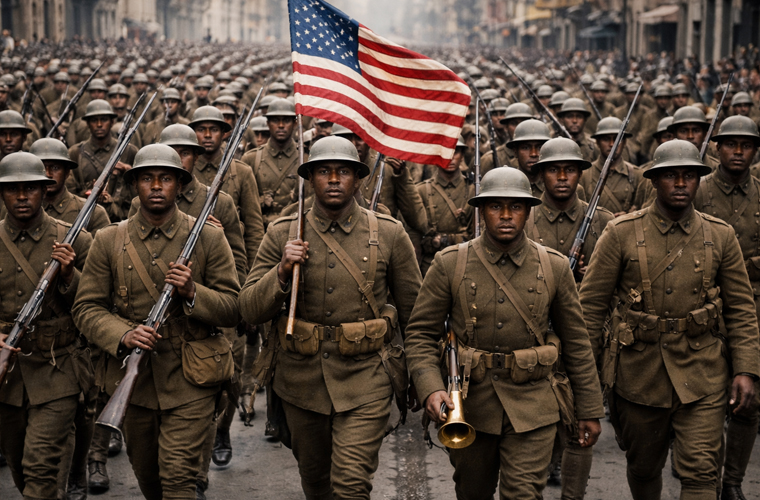
Forged in Fire, Unbroken in Spirit
In the dim predawn hours of May 15, 1918, amid the scarred earth of no-man’s-land near the French village of Toul, Private Henry Johnson of the 369th Infantry Regiment crouched in a shallow observation post. A German raiding party of at least two dozen soldiers descended upon him and his comrade, Needham Roberts, hurling grenades and unleashing a hail of bullets. Wounded multiple times—shrapnel tearing into his leg, side, shoulder, and thigh—Johnson refused to yield. He fired his rifle until it jammed, then wielded it as a club, and finally drew his bolo knife, stabbing and slashing with ferocious resolve. By the time the Germans retreated, Johnson had killed at least four and wounded dozens more, saving Roberts and securing vital intelligence. For this act of raw courage, he earned the nickname “Black Death” and became the first American to receive France’s Croix de Guerre. Johnson’s story encapsulates the essence of the Harlem Hellfighters: an all-Black regiment that faced not only the horrors of World War I but also the entrenched racism of their own nation, emerging as one of the most decorated units in American military history.
Roots in Resilience: Formation Amid Adversity
The Harlem Hellfighters trace their origins to the vibrant streets of Harlem in 1913, when New York City’s African American community, led by civil rights advocates like the National Association for the Advancement of Colored People (NAACP) and figures such as W.E.B. Du Bois, lobbied for the creation of the 15th New York National Guard Regiment. On June 2, 1913, Governor William Sulzer signed the bill into law, marking the first Black combat unit in the New York National Guard. Sponsored by the elite Union League Club of New York, the regiment drew recruits from Harlem’s working-class neighborhoods—porters, laborers, and barbers—who saw military service as a path to equality and respect.
When the United States entered World War I in April 1917, the 15th New York was federalized on July 25 and redesignated the 369th Infantry Regiment in March 1918. Under the command of white Colonel William Hayward, a progressive attorney who insisted on treating his men as equals, the unit trained at Camp Whitman in New York and later at Camp Wadsworth in Spartanburg, South Carolina. There, they encountered the full brunt of Jim Crow racism: white locals hurled slurs, threatened violence, and even kicked Black soldiers like musician Noble Sissle in the streets. Hayward’s firm response—demanding reports of incidents without retaliation—fostered unbreakable unit cohesion, but the prejudice foreshadowed deeper challenges. Initially assigned to menial labor duties upon arrival in France on December 27, 1917, the 369th was soon attached to the French 16th Division on April 8, 1918, due to American segregation policies that barred Black troops from serving alongside white units. Equipped with French rifles, helmets, and gas masks while retaining their U.S. uniforms, they trained rigorously under General Henri Gouraud, embracing the French Army’s egalitarian ethos.


Trial by Fire: 191 Days of Unyielding Combat
The Harlem Hellfighters earned their fearsome moniker—likely coined by awestruck German foes who dubbed them “Hellfighters” for their relentless ferocity—from the moment they entered the trenches on May 8, 1918. Over the next 191 days, they endured continuous frontline service, outlasting any other American outfit and suffering 1,500 casualties—the highest toll of any U.S. regiment. Never losing an inch of ground or a single man to capture (they even rescued two captured comrades), the 369th became a symbol of indomitable will.
Their baptism came during the German Spring Offensive in the Champagne region, where they manned exposed positions amid relentless artillery barrages and gas attacks. In the Second Battle of the Marne (July 15–18, 1918), they counterattacked with bayonets fixed, losing 14 killed and 51 wounded but halting the enemy advance. The Meuse-Argonne Offensive in September 1918 proved their crucible: From September 26 to October 15, the Hellfighters spearheaded assaults through barbed wire and machine-gun nests, capturing the fortified village of Séchault on September 29 at a staggering cost—144 dead and nearly 1,000 wounded. Advancing 14 kilometers against elite German troops, they seized a critical railroad junction, earning 171 individual French medals and the regiment’s collective Croix de Guerre for “magnificent” valor. On November 11, 1918, as the Armistice echoed, the 369th stood in the Vosges Mountains, the first Allied unit to cross the Rhine on November 26.
| Key Battles | Date | Role and Outcome |
|---|---|---|
| Champagne-Marne Defensive | May–July 1918 | Held lines during German offensive; minimal ground lost. |
| Second Battle of the Marne | July 15–18, 1918 | Counterattacked, repelling enemy; 65 casualties. |
| Meuse-Argonne Offensive | September 26–October 15, 1918 | Captured Séchault and advanced 14 km; 1,144 casualties. |
| Alsace 1918 | Late 1918 | Patrolled and secured Rhine crossing. |
.
Heroes in the Trenches: Tales of Extraordinary Valor
Beyond the collective grit, individual stories illuminated the Hellfighters’ humanity and heroism. Henry Johnson, a slight 5’4″ porter from Albany, New York, embodied their spirit; his 1918 raid not only thwarted a German breakthrough but also made headlines worldwide, challenging stereotypes of Black soldiers as unfit for combat. Though denied the Medal of Honor in his lifetime—he died penniless in 1929 from war-related health issues—it was awarded posthumously in 2015, alongside Roberts.
Lieutenant James Reese Europe, a Harlem Renaissance pioneer and violin virtuoso, brought rhythm to the regiment as bandleader. His 369th Hellfighters Band—featuring talents like Noble Sissle and Eubie Blake—marched into battle playing syncopated jazz, lifting spirits amid the mud and mustard gas. Gassed during combat, Europe composed “On Patrol in No Man’s Land,” a haunting reflection of trench life, and introduced American jazz to European audiences, performing for 50,000 in Paris and influencing global music. Tragically, he was murdered in 1919 by a bandmate, but his legacy fueled the Harlem Renaissance.
Other luminaries included Sergeant Walter Loving, a pioneering bugler, and future general Benjamin O. Davis Sr., who commanded the regiment in the interwar years. Their exploits—171 Croix de Guerre recipients, including the entire unit—shattered myths of Black inferiority, proving valor knows no color.
Echoes of Jazz and Justice: Cultural and Civil Rights Ripples
The Hellfighters’ band was more than morale boosters; they were cultural ambassadors. Syncopated rhythms once dismissed as “barbaric” by some Americans captivated French crowds, paving the way for jazz’s worldwide embrace and symbolizing Black excellence on a global stage. Back home, the regiment’s February 17, 1919, ticker-tape parade up Fifth Avenue—denied to them upon departure—drew 100,000 Harlem residents, turning the day into an unofficial holiday.
Yet victory was bittersweet. Returning to a segregated America, the Hellfighters faced the Red Summer of 1919 race riots and broken promises of equality. Johnson’s 1919 testimony demanding fair hiring for veterans highlighted the hypocrisy: “We made the world safe for democracy, but not for ourselves.” Their service fueled the NAACP’s anti-lynching campaigns and early civil rights momentum, inspiring generations to demand the rights they fought for.
A Legacy Etched in Bronze
Demobilized on February 28, 1919, the 369th was reconstituted in the National Guard and served in World War II, though without the WWI lineage. Honors accrued over decades: the French Croix de Guerre (1918), a U.S. Congressional Gold Medal (2021), and tributes like the 369th Regiment Armory (a Harlem landmark since 1985) and the renamed Harlem Hellfighters Drive (2003). Monuments, films like Men of Bronze (1977), and Sabaton’s 2022 anthem “Hellfighters” keep the flame alive.
The Harlem Hellfighters were more than soldiers; they were warriors against two foes—tyranny abroad and injustice at home. In an era that sought to diminish them, they roared back with unbreakable resolve, reminding us that true heroism lies in fighting the good fight, no matter the odds. As General John J. Pershing proclaimed, they were “fighting like lions.” Their story endures, a testament to the power of the overlooked to reshape history.