
A Forgotten Atrocity of the Atlantic Slave Trade
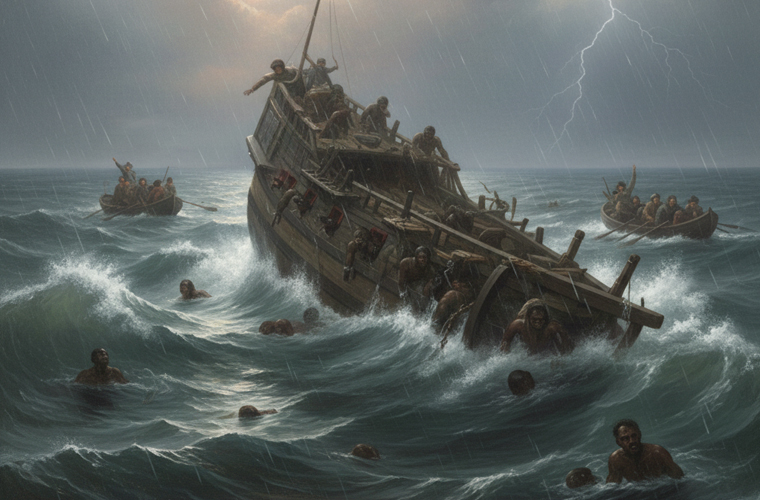
In the annals of human suffering, few events stand out as starkly as the sinking of the Dutch slave ship Leusden on January 1, 1738. What began as a routine voyage in the brutal machinery of the transatlantic slave trade ended in one of history’s greatest maritime massacres, claiming the lives of over 660 enslaved Africans in a deliberate act of abandonment. This tragedy, long overshadowed by more infamous episodes like the Zong massacre, highlights the calculated inhumanity embedded in the era’s economic empire-building. Drawing from archival records and recent archaeological efforts, the story of the Leusden serves as a grim reminder of the scale of loss during the Dutch involvement in the slave trade.
Launched in 1719 from the De Eendracht shipyard in Amsterdam—meaning “The Unity” in Dutch—the Leusden was a sturdy flute ship designed for efficiency in the lucrative triangle of trade. Owned by the Dutch West India Company (WIC), it plied routes between Europe, West Africa, and the Americas, transporting goods, gold, and, most horrifically, human cargo. By the 1730s, the WIC had transported over 500,000 enslaved Africans across the Atlantic, with the Leusden completing multiple successful voyages before its fateful end.
The ship’s final journey began in August 1737 from the Gold Coast of West Africa, departing the notorious fortress of Elmina in present-day Ghana. Aboard were approximately 700 enslaved men, women, and children, captured from regions including modern-day Ghana, Togo, and Benin. Chained below decks in suffocating conditions, they endured the Middle Passage—a grueling 50-day crossing marked by disease, starvation, and abuse. Mortality rates on such voyages often exceeded 20%, and by the time the Leusden neared Suriname, nearly a quarter of its human cargo had already perished. The survivors were destined for the sugar plantations of the Dutch colony, where they would fuel Europe’s sweet tooth through unimaginable toil.
Captain Joachim Outjes commanded the vessel, supported by a crew of around 40. The Leusden carried not only lives but also valuables: a casket of 8,000 gold coins, the fruits of African labor extracted by the WIC. As the ship approached the Maroni River estuary on December 31, 1737, hope flickered for the captives—land was in sight after months of torment.
Fate intervened with ferocious weather. A violent storm battered the Leusden as it attempted to navigate the shallow, treacherous mouth of the Maroni River, now straddling the border between Suriname and French Guiana. The winds drove the ship aground on a sandbar, where it began to list and take on water. Rather than capsize instantly, the vessel settled slowly, buying precious time—or, in this case, enabling a calculated betrayal.
Outjes, fearing for his life and the gold, ordered the crew to prepare the longboat and yawl for evacuation. But the captain’s priorities extended beyond self-preservation. To secure the lifeboats, he commanded his men to nail shut the hatches leading to the slave holds. Approximately 664 to 702 terrified individuals—most shackled in the lower decks—were thus condemned. They pounded on the sealed barriers, their cries drowned out by the storm, as the ship filled with water. Suffocation and drowning claimed them in the darkness below, while 14 to 16 enslaved people who had been brought on deck for airing were allowed to board the boats and survive alongside the crew.
The crew rowed to safety at nearby plantations, towing the precious gold casket. When rescuers returned hours later, the Leusden was a watery tomb, its bow submerged and stern awash. Divers later recovered some bodies, but the majority remained entombed in the riverbed, a silent testament to the crew’s actions. This was no accident of nature but a deliberate choice. Outjes later claimed the hatches were sealed to prevent a slave revolt that could overwhelm the escaping crew—a flimsy justification rooted in the pervasive paranoia of the trade. Historians like Johannes Postma argue it exemplified the disposable view of enslaved lives: the Leusden disaster dwarfed even the Zong’s 132 deaths, marking it as the single deadliest incident in the Atlantic slave trade.
The survivors’ fates underscored the system’s callousness. The 14 to 16 enslaved Africans who reached shore were promptly sold at a public auction in Paramaribo, Suriname’s capital, their brief reprieve erased by the market’s demands. The crew, meanwhile, was hailed as heroes by the WIC. They received bonuses for salvaging the gold—equivalent to years of wages—while Outjes faced a perfunctory inquiry in Amsterdam. Acquitted on grounds of necessity, he resumed his career, the company’s profit margins intact.
The WIC’s archives, preserved in the Dutch National Archives, meticulously recorded the losses: not just lives, but depreciated assets on a ledger. This bureaucratic detachment fueled outrage among later scholars. As historian Leo Balai notes in his 2011 book The Leusden Slave Ship: A Story of Mutiny, Shipwreck and Murder, the event exposed the rot within the Dutch trade, contributing to the WIC’s declining fortunes and its eventual exit from slaving by 1734—though the Leusden predated that shift.
For nearly three centuries, the Leusden slumbered in obscurity, its story buried like its victims. That changed in the 21st century through the efforts of the Slave Wrecks Project, a UNESCO-backed initiative involving the Smithsonian’s National Museum of African American History and Culture and Diving With a Purpose. In 2013, researchers confirmed the wreck’s location in the Maroni River using sonar and historical maps, revealing cannons, anchors, and ballast stones amid the silt.
Public remembrance followed. The Scheepvaart Museum (National Maritime Museum) in Amsterdam mounted a poignant 2013 exhibition: visitors descended into a replica hold, enveloped by recorded voices reciting names, ages, and capture dates from WIC logs. The display culminated in a field of virtual gravestones, each etched with a lost life—a visceral counter to the trade’s dehumanization. In Suriname, local communities have begun integrating the story into oral histories, while global calls grow for more wreck protection under international law.
The Leusden tragedy endures as a microcosm of the transatlantic slave trade’s horrors: an estimated 12.5 million Africans were forcibly embarked, with 1.8 million perishing en route. It challenges modern narratives of Dutch history, often sanitized as one of “tolerance,” to confront complicity in genocide-scale suffering.
The Leusden’s ghosts whisper across the Maroni’s muddy waters, urging accountability. As climate change and development threaten such sites, preserving them is not mere archaeology—it’s restitution. In remembering the 664 souls sealed below, we honor their humanity, stolen yet unbroken. The ship’s unity was a lie; true solidarity lies in bearing witness to its unraveling.