
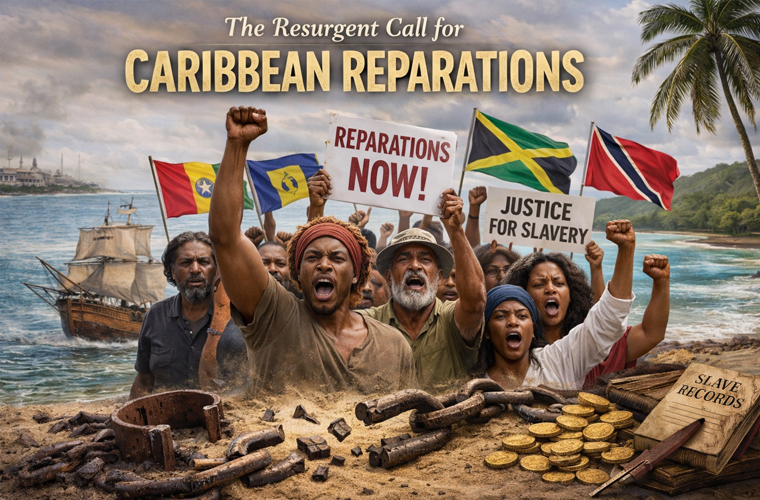
In the sun-drenched islands of the Caribbean, where turquoise waters lap against shores once stained by chains, a powerful chorus is rising once more. For centuries, the region has grappled with the enduring scars of European colonialism and the transatlantic slave trade—a brutal legacy that forcibly uprooted over 12.5 million Africans, subjecting them to unimaginable horrors of enslavement and exploitation. As of early 2026, calls for reparations have intensified, transforming from academic debates into a global movement demanding accountability, justice, and healing. Led by the Caribbean Community (CARICOM), these demands challenge former colonial powers like Britain, France, and the Netherlands to confront their historical debts—not just in words, but in tangible restitution.
A Legacy Forged in Chains
The story begins in the 15th century, when European powers descended upon the Americas, decimating indigenous populations through genocide, disease, and displacement. What followed was the “Middle Passage,” a harrowing voyage across the Atlantic that claimed countless lives and birthed a racialized system of chattel slavery. Plantations in Jamaica, Barbados, and Haiti flourished on the backs of enslaved Africans, generating immense wealth for Europe while sowing seeds of intergenerational trauma, economic disparity, and cultural erasure in the Caribbean.
Even after emancipation in the 19th century, the wounds festered. Freed people were thrust into indentured labor systems, denied land ownership, and saddled with discriminatory policies that perpetuated poverty. Today, these historical injustices manifest in stark realities: high rates of chronic illness, educational inequities, and vulnerability to climate change—exacerbated by colonial-era environmental exploitation. As one activist poignantly noted, “Slavery didn’t end; it evolved.”
CARICOM’s Blueprint for Justice: The 10-Point Plan
At the heart of the reparations movement is the CARICOM Reparations Commission (CRC), established in 2010 to build a moral, ethical, and legal case against former colonial powers. In 2013, the CRC unveiled its landmark 10-Point Plan for Reparatory Justice—a comprehensive framework aimed at reconciliation, truth-telling, and socio-economic restoration. This plan shifts the focus from mere financial payouts to holistic redress, addressing the multifaceted damages of slavery and colonialism.
| Point | Description |
|---|---|
| 1. Full Formal Apology | Official acknowledgments from governments and institutions for their roles in genocide, enslavement, and exploitation. |
| 2. Repatriation | Funding and support for descendants of the enslaved to return to Africa if desired, fostering cultural reconnection. |
| 3. Indigenous Peoples Development Program | Investments in health, education, and land rights for surviving indigenous communities decimated by colonialism. |
| 4. Cultural Institutions | Establishment of museums and heritage sites, plus the repatriation of stolen artifacts to reclaim stolen narratives. |
| 5. Public Health Crisis | Resources to combat chronic diseases linked to the nutritional and psychological traumas of slavery. |
| 6. Illiteracy Eradication | Universal education programs to counter the denial of learning imposed on enslaved people. |
| 7. Historical Knowledge Exchanges | Curricula reforms to teach accurate histories of slavery in schools worldwide, combating denialism. |
| 8. Psychological Rehabilitation | Therapy and community programs to heal intergenerational trauma passed down through generations. |
| 9. Technological Development | Transfer of green energy and digital technologies to bridge the development gap created by exploitation. |
| 10. Debt Cancellation | Forgiveness of international debts and direct development aid to repair economic sabotage. |
.
The plan emphasizes that reparations are not about punishment but restorative justice, echoing broader global reckonings—from Germany’s Holocaust reparations to New Zealand’s Treaty of Waitangi settlements.
Momentum Builds: Recent Developments
The past year has seen unprecedented traction. In November 2025, Caribbean leaders visited the UK for high-level talks on slavery reparations, pressing for concrete commitments amid growing international solidarity. Apologies have trickled in: British broadcaster Laura Trevelyan issued a formal one on behalf of her slave-trading ancestors in Grenada, while educational reforms in the Caribbean prioritize anti-colonial curricula.
Across the Atlantic, Africa’s involvement has amplified the call. The African Union’s 2025 reparations summit linked Caribbean and continental demands, framing them as a unified fight against “genocide-enabled domination.” Even symbolic gestures, like the return of a taxidermied Caribbean animal specimen to its island of origin, underscore the push for cultural restitution.
Yet, 2026 has brought fresh controversies. In the UK, Foreign Secretary David Lammy—whose parents hail from Guyana—faced backlash for advocating reparations, with critics questioning his loyalties. On social media, debates rage: One user highlighted Scotland’s deep ties to the slave trade, urging accountability for surnames like “Mc-something” in Caribbean communities. Meanwhile, U.S. President Trump’s withdrawal from a UN forum pushing global reparations drew cheers from some, who argued it protects “lineage-based” claims for African Americans over broader international ones.
Hurdles on the Horizon
Despite the progress, obstacles loom large. Geopolitical tensions—wars, economic instability—make former powers reluctant, with some dismissing reparations as “unfeasible” in a divided world. Critics argue that quantifying centuries of harm is impossible, while others fear it could strain Commonwealth ties. Public opinion remains polarized; a recent X thread lamented how Caribbean descendants “just finished paying off reparations to English planters in 2015,” flipping the narrative on who owes whom.
Advocates counter that inaction perpetuates inequality. Studies show reparations could slash health disparities and boost economies, as seen in hypothetical U.S. models reducing COVID-19 impacts among Black communities. The CRC insists: Without redress, true decolonization remains a mirage.
Toward a Reparative Future
As 2026 unfolds, the Caribbean’s reparations call resonates beyond its shores, inspiring movements from Brazil to Benin. It’s a reminder that history isn’t inert—it’s a living debt demanding settlement. Whether through apologies etched in law or funds flowing to forgotten communities, the path forward lies in acknowledgment. In the words of the CRC, this is about “reconciliation, truth, and justice” for millions whose stories were silenced but never erased.
The question now is not if, but when. The Caribbean waits no longer.