
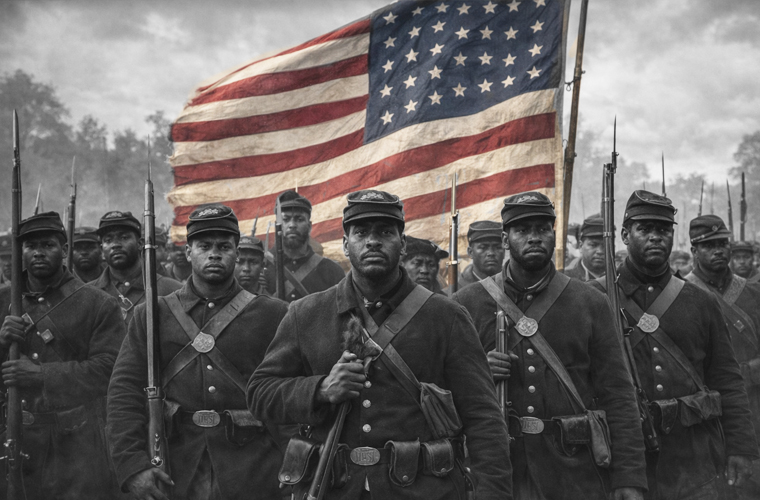
Forging Freedom on the Battlefield
In the crucible of the American Civil War, a force emerged that not only bolstered the Union Army’s ranks but also struck at the heart of the institution of slavery itself. The United States Colored Troops (USCT) represented the largest organized military effort by African Americans in U.S. history up to that point, comprising regiments of Black soldiers who fought with valor amid profound adversity. From 1863 to 1865, approximately 178,000 to 185,000 African American men donned Union blue, forming about one-tenth of the total Union forces. These soldiers—many formerly enslaved, others free-born—served in infantry, artillery, cavalry, and engineering roles, proving their mettle in over 39 major engagements and hundreds of skirmishes. Their story is one of resilience, sacrifice, and a pivotal contribution to the war’s outcome, ultimately reshaping the nation’s understanding of citizenship and equality.
The Spark of Formation: From Emancipation to Enlistment
The path to the USCT’s creation was paved by the shifting tides of war and the unyielding demand for manpower. At the outset of the Civil War in 1861, the Union prohibited Black enlistment, fearing it would alienate border states and complicate diplomatic relations with slaveholding nations like Britain. African Americans, however, clamored to serve, drawing on a legacy of military participation from the Revolutionary War onward. Unofficial units began forming as early as 1862, such as the First Kansas Colored Infantry, which clashed with Confederate guerrillas at the Battle of Island Mound in Missouri on October 27, 1862—the first combat action by Black troops in the war.
The turning point came with President Abraham Lincoln’s Emancipation Proclamation, issued on January 1, 1863. This decree not only freed enslaved people in Confederate-held territories but also explicitly authorized the enlistment of “persons of African descent” into the Union military for garrison duty and on naval vessels. To organize this influx, the War Department issued General Order No. 143 on May 22, 1863, establishing the Bureau of Colored Troops (later renamed the Bureau of U.S. Colored Troops). This bureau standardized recruitment, training, and deployment, absorbing existing state-raised units like the First South Carolina Volunteers (African Descent) and the Louisiana Native Guards into the federal system.
Recruitment surged thereafter. Secretary of War Edwin M. Stanton dispatched General Lorenzo Thomas to the Mississippi Valley in March 1863 to rally freedmen and slaves, promising freedom and pay to enlistees. Northern states contributed around 79,000 soldiers, while Southern states—through contraband camps and manumission incentives—provided over 93,000 more. In border states like Kentucky and Tennessee, owners could receive up to $300 compensation for enlisting their slaves, accompanied by deeds of manumission. By war’s end, 175 regiments had been raised, with enlistees hailing from every state and even Canada and the West Indies.
Into the Fray: Roles and Heroism in Battle
Initially relegated to labor-intensive tasks—building fortifications like Fort Pocahontas in Virginia or serving as teamsters and cooks—USCT regiments soon proved their combat worth. Their first official federal action came in coastal assaults, but it was the 54th Massachusetts Infantry’s assault on Fort Wagner, South Carolina, on July 18, 1863, that captured national attention. Immortalized in the film Glory, the regiment’s charge resulted in heavy losses, including the death of Colonel Robert Gould Shaw, but Sergeant William Carney earned the Medal of Honor for rescuing the regimental colors under fire—the first Black soldier to receive the nation’s highest military honor.
USCT units saw action across all theaters: the Siege of Petersburg, Virginia, where the 30th USCT helped dig the mine for the Battle of the Crater in July 1864, suffering devastating casualties in the ensuing assault; the Battle of Nashville in December 1864, where four USCT regiments charged entrenched Confederates; and the final push into Richmond in April 1865, with the 5th USCT among the first to enter the fallen Confederate capital. General Ulysses S. Grant, who integrated Black troops into his Army of the Tennessee, lauded their reliability: “Negro troops are easier to preserve discipline among than our white troops… All who have been tried have fought bravely.”
In total, USCT soldiers participated in 449 battles and skirmishes, with 68,178 killed or wounded—about 20% of their ranks, a rate 35% higher than white Union troops, largely due to disease in camp. Sixteen to eighteen received the Medal of Honor, a testament to their bravery amid unequal odds.
Shadows of Discrimination: The Cost of Service
For all their heroism, USCT soldiers endured systemic racism that permeated their service. White officers exclusively commanded regiments, selected through rigorous exams, while Black non-commissioned officers were limited to sergeant roles; only about 110 African Americans became commissioned officers, mostly as chaplains or surgeons. Pay was another grievance: Black soldiers initially received $10 per month (with $3 deducted for clothing), half the white rate, until Congress equalized it in June 1864 after advocacy by figures like Frederick Douglass.
The gravest threat came from Confederate policy. A May 1863 decree by President Jefferson Davis labeled captured USCT soldiers as “slaves in arms,” subjecting them to re-enslavement or execution rather than prisoner-of-war status. Massacres, such as at Fort Pillow, Tennessee, in April 1864—where over 200 USCT troops were killed post-surrender—underscored this peril. Personal accounts reveal the human toll: Letters from soldiers like Samuel Cabble of the 55th Massachusetts begged for funds to support impoverished families back home, while wounded veterans like Pvt. Louis Martin of the 29th USCT endured amputations without adequate care.
A Lasting Legacy: From Battlefield to Bronze
The USCT mustered out in late 1865, but its influence continued to endure. Many veterans formed the nucleus of the post-war Regular Army’s Black units—the famed Buffalo Soldiers—who served in the Indian Wars and Spanish-American War. Their service lent credence to Douglass’s rallying cry: “Once let the black man get upon his person the brass letters U.S…. and there is no power on earth which can deny that he has earned the right of citizenship.” The 13th, 14th, and 15th Amendments, which abolished slavery and granted citizenship and voting rights, owed much to the visible proof of Black loyalty and valor.
Today, the USCT’s legacy is preserved in archives holding 185,000 service records, pension files, and poignant letters that humanize the statistics. Monuments like the African American Civil War Memorial in Washington, D.C., dedicated in 1998, and ongoing digitization efforts by the National Archives ensure their stories endure. Exhibitions at sites like the Atlanta History Center highlight artifacts from the 175 regiments, reminding us that the fight for freedom was not just a white man’s war.
The United States Colored Troops did not merely serve; they embodied the war’s moral imperative. In uniform, they claimed agency over their destiny, turning the tide of history one battle—and one unbreakable spirit—at a time. As we reflect on their sacrifices, their legacy challenges us to confront the unfinished work of equality in America.