
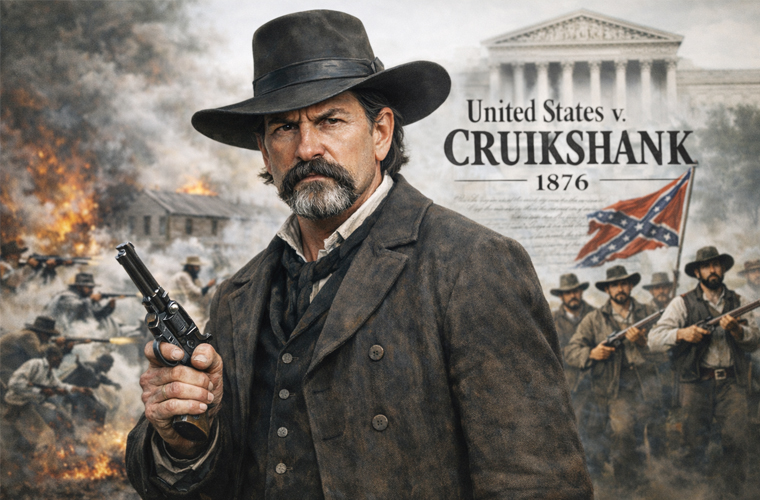
William J. Cruikshank (also referred to as William “Bill” Cruikshank or W. J. Cruikshank, c. 1839–1920) was a 19th-century American planter, local political figure, and white supremacist paramilitary leader in Grant Parish, Louisiana, best known for his central role in the Colfax Massacre of 1873 and as the lead defendant in the landmark U.S. Supreme Court case United States v. Cruikshank (1876).
Early Life and Background
Limited detailed personal records exist, but genealogical sources indicate William J. Cruikshank was born around 1839 in New York (possibly to parents Peter Cruikshank and Elizabeth McKnight) and later moved to Louisiana. By the post-Civil War era, he had become a prominent cotton planter in the Red River region of central Louisiana. He served as a police juror (a local elected official equivalent to a county commissioner) in Grant Parish, which was established in 1869 during Reconstruction and had a majority-Black population. As a planter in the Reconstruction South, Cruikshank represented the interests of white Democrats and former Confederates who sought to regain political and economic control from freedmen, Republican officials, and “carpetbaggers.”
The Colfax Massacre (April 13, 1873)
Cruikshank’s notoriety stems from the bloodiest single act of racial violence during the Reconstruction era. Following the disputed 1872 Louisiana gubernatorial election (between Republican William P. Kellogg and Democrat John McEnery), tensions escalated in Grant Parish over control of the parish courthouse in Colfax. Black freedmen and Republican state militia occupied the courthouse to defend the elected Republican officials amid widespread fraud and intimidation.
On Easter Sunday, April 13, 1873, a force of 150–300 armed white men—many former Confederates, including members of white supremacist groups akin to the Ku Klux Klan or White League—attacked the courthouse. They used rifles, a small cannon, and superior tactics to overwhelm the roughly equal number of Black defenders behind earthworks. After several hours of fighting, the Black militiamen surrendered under a white flag of truce.
What followed was a massacre: Most of the surrendering Black men (estimates range from 62 to over 150 killed, with many bodies thrown into the Red River or burned) were executed in cold blood. Survivors were taken prisoner, and later that evening or night, William J. “Bill” Cruikshank led or participated in the summary execution of dozens more prisoners. Contemporary accounts and later histories describe him ordering or directly participating in killings, with survivors identifying him as a shooter. Three white attackers also died in the initial fighting. Historian Eric Foner and others have described it as the worst single incident of racial terrorism during Reconstruction, intended to suppress Black political participation and Republican control in the parish.
Arrest, Trial, and United States v. Cruikshank (1876)
Federal authorities, using the Enforcement Act of 1870 (part of the Ku Klux Klan Acts aimed at protecting Black civil rights), indicted nearly 100 men, with nine (including Cruikshank, John P. Hadnot, and William B. Irwin) standing trial in New Orleans. The charges involved conspiring to deprive victims of their constitutional rights, including the right to assemble (First Amendment), bear arms peaceably (Second Amendment), and equal protection/due process under the Fourteenth Amendment.
In 1874, a federal circuit court convicted Cruikshank and two others on conspiracy charges (though not murder). The convictions were appealed. In a landmark 1876 ruling, the U.S. Supreme Court unanimously overturned them in United States v. Cruikshank. Chief Justice Morrison Waite’s opinion held that the Bill of Rights and Fourteenth Amendment protections applied only against state action, not private individuals or conspiracies. The federal government thus lacked authority to prosecute such private violence; victims had to seek redress in state courts (which were often unwilling or unable to act against white supremacists).
The decision severely weakened federal enforcement of Reconstruction-era civil rights laws, emboldened white paramilitary groups, contributed to the end of Reconstruction (via the Compromise of 1877), and laid the groundwork for the Jim Crow era. It was not fully overcome until mid-20th-century civil rights advancements and cases like Brown v. Board of Education and the Voting Rights Act. Cruikshank and the others were released and faced no further punishment.
Later Life, Family, and Death
After the trials, Cruikshank returned to life as a planter. He lived in Washington County, New York, later in life (per census and family records) and had at least one child. He died in 1920. Descendants, including great-grandsons Douglas and Stephen Cruikshank, have publicly acknowledged his role in modern commemorations. A 1950 historical marker at the Colfax site (later removed in 2021 for biased language, calling it a “riot” that ended “carpetbag misrule”) downplayed the massacre. In 2023, a new memorial was unveiled to honor the victims.
Historical Significance and Legacy
Cruikshank was not a national figure but a local leader whose actions and case had a profound national impact. He embodied the violent resistance to Black enfranchisement and federal authority in the post-Civil War South. The Cruikshank precedent hindered civil rights prosecutions for decades and is still studied in constitutional law for its narrow interpretation of federal power and the Fourteenth Amendment’s “state action” doctrine.
Modern scholarship (e.g., books such as The Colfax Massacre by LeeAnna Keith and The Day Freedom Died by Charles Lane) draws on trial transcripts, survivor testimonies (such as those of Levi Nelson), and contemporary reports to detail the events. Cruikshank’s role is consistently highlighted as that of a key organizer and executioner.
Note: There have been other individuals named William Cruikshank (e.g., a Scottish-Canadian painter, 1848–1922; an anatomist; or modern figures), but the “J.” designation and historical context point overwhelmingly to the Louisiana figure associated with these events. Comprehensive biographies are scarce due to the era’s record gaps, with most information coming from legal histories, Reconstruction scholarship, and genealogical data.