
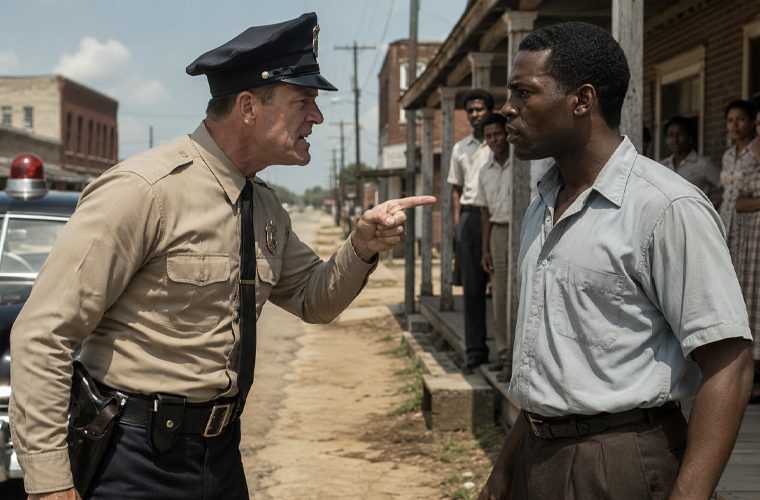
On June 21, 1940, in Luverne, Alabama, a trivial act of speech cost 26-year-old Jesse Thornton his life.
Thornton, a Black resident of the small Crenshaw County town, was walking when he referred to a passing white police officer by his first name: Doris Rhodes. In the rigidly hierarchical world of Jim Crow Alabama, addressing a white man—especially a law enforcement officer—without the obligatory “Mister” was an unpardonable breach of racial etiquette. When Officer Rhodes overheard the remark, he demanded Thornton explain himself. Thornton quickly tried to correct his words, addressing the officer as “Mr. Doris Rhodes.” It was not enough. Enraged, Rhodes hurled a racial slur at Thornton, struck him, and knocked him to the ground. He then arrested Thornton and hauled him to the city jail. Outside, a mob of white men began to gather, their anger palpable and growing.
Fearing for his life, Thornton attempted to escape. He managed to break away and flee a short distance, but the mob gave chase. They pursued him with gunfire, bricks, bats, and stones. Wounded by bullets and battered by the hail of objects, Thornton soon collapsed. The mob seized him, threw his body into a truck, and drove to an isolated spot. There, they dragged him into a nearby swamp and shot him again at close range.
A local fisherman discovered Thornton’s badly decomposed and vulture-ravaged body one week later, floating in the Patsaliga River near Luverne.
Investigation and Impunity
Local NAACP leader Dr. Charles A.J. McPherson of Birmingham documented the lynching in a detailed report. The document was forwarded to the U.S. Department of Justice by NAACP lawyer Thurgood Marshall, who would later become the first Black Supreme Court Justice. Marshall urged federal authorities to investigate.
The Department of Justice directed the FBI to examine whether local law enforcement or other officials had been complicit in the murder. Despite this, no one was ever prosecuted for Thornton’s killing. His death became one of thousands of documented lynchings in the United States—particularly in the South—during the Jim Crow era, where racial terror was frequently met with official indifference or outright participation.
Jesse Thornton’s murder stands as a stark example of how everyday interactions, governed by the unwritten rules of white supremacy, could swiftly escalate into lethal violence, and how the systems meant to deliver justice often failed Black Americans in the most profound ways.