
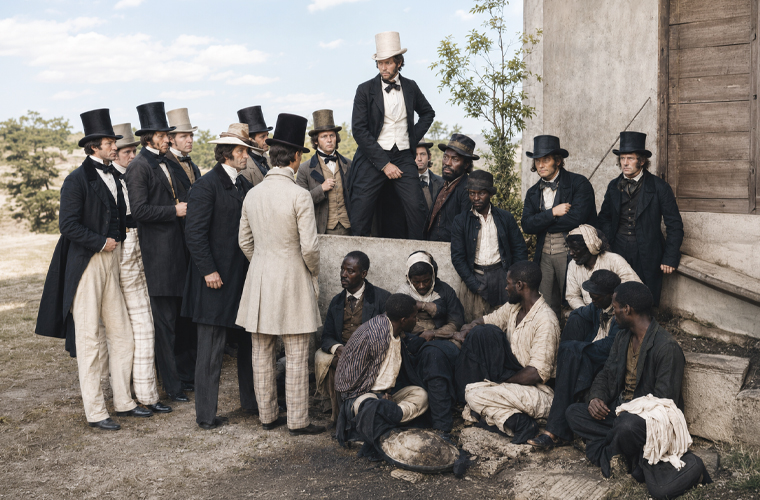
In early March 1859, rain fell relentlessly on the Ten Broeck Race Course just west of Savannah, Georgia. For two days, as more than 400 enslaved men, women, and children stood on the auction block, the sky poured without pause. When the final sale concluded, the clouds parted. Those who lived through it, and their descendants, named the event “The Weeping Time”—a phrase that captured both the heavens’ apparent mourning and the human grief of families torn apart.
The Background: Debt and Inheritance
The people sold belonged to Pierce Mease Butler, grandson of Major Pierce Butler, a signer of the U.S. Constitution and a wealthy South Carolina-Georgia planter who had helped shape the Fugitive Slave Clause. The younger Butler inherited half of the family’s vast Georgia holdings: a rice plantation on Butler Island near Darien and a Sea Island cotton plantation on St. Simons Island. Together, the properties held roughly 900 enslaved people, many of whom had lived their entire lives in the tightly knit Gullah-Geechee communities of the coastal lowcountry.
By the late 1850s, Pierce Butler had squandered much of his fortune through gambling, stock speculation, and lavish living in Philadelphia. The Panic of 1857 accelerated his collapse. Trustees took control of his affairs. After selling his Philadelphia mansion and other assets, they determined that the only remaining property of sufficient value was human. They would sell approximately half of the enslaved population—those allotted to Pierce—to settle his debts.
The Auction
Slave broker Joseph Bryan advertised the sale for weeks in newspapers across the South: “Long Cotton and Rice Negroes… a gang of 440… among them are several good mechanics and house servants.” Savannah was chosen for its status as a major slave-trading center and its proximity to the plantations. When Johnson Square proved too small for the expected crowds, the venue shifted to the Ten Broeck Race Course, about two miles west of downtown.
On March 2 and 3, 1859, buyers from Georgia, the Carolinas, Alabama, Louisiana, and beyond gathered despite the driving rain. The enslaved people had been brought by steamboat and rail and housed in the racecourse stables. The catalog listed 436 individuals; 429 were actually sold (the rest were ill or otherwise withheld). Among them were field hands, carpenters, blacksmiths, coopers, shoemakers, cooks, and about thirty infants. The youngest was only weeks old.
Butler’s agents claimed families would not be broken up, and many lots were sold as family units. Still, separations occurred. Young adults, the elderly, and some spouses were sold apart. Newly married couples were parted on their “honeymoon.” Mothers with nursing babies fetched higher prices. The two-day sale brought $303,850—roughly the equivalent of more than $10 million today. Individual prices ranged from about $250 to $1,750; one mother and her five grown children sold for the highest family price of $6,180.


