
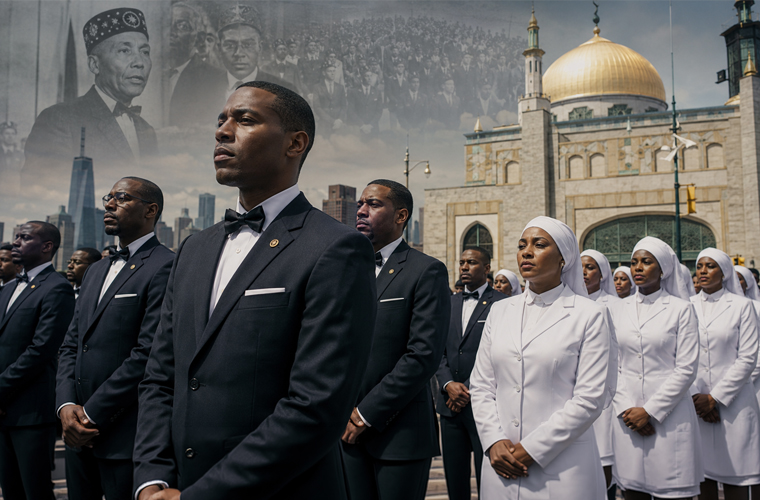
The Nation of Islam (NOI) is a religious and Black nationalist organization founded in the United States in 1930. It blends elements of Islamic terminology and practice with Black empowerment, self-reliance, and separatism. While it presents itself as an Islamic movement and has introduced many African Americans to aspects of Islam, its theology diverges significantly from orthodox Sunni or Shia Islam, leading many mainstream Muslims to view it as a distinct new religious movement. The NOI emphasizes racial pride, economic independence, moral discipline, and community reform, particularly among African Americans. It gained prominence in the mid-20th century through charismatic leaders and its appeal during the Civil Rights era, though it has also faced criticism for separatist and supremacist teachings.
Origins and Early History
The NOI traces its founding to Wallace D. Fard Muhammad (also known as W.D. Fard or Master Fard Muhammad), who appeared in Detroit, Michigan, around 1930. Fard preached to African Americans in the ghetto, teaching them about their “true” identity as members of the original Black nation (the Tribe of Shabazz from Asia) and offering knowledge of God and self-reliance. He claimed his mission was to resurrect the “lost-found” Black people from mental and spiritual death after centuries of slavery and oppression.
Fard disappeared mysteriously in 1934. His chosen successor, Elijah Poole (later Elijah Muhammad, 1897–1975), took leadership. Elijah Muhammad taught that Fard was “God in person” (Allah), the Mahdi, or the fulfillment of prophecies across religions. Under Elijah Muhammad, the organization grew from a small Detroit group to a national movement with temples (mosques) in major cities, schools (Universities of Islam), and programs promoting clean living.
The NOI expanded rapidly in the 1950s and 1960s, attracting members through its message of Black pride, rejection of integrationist approaches, and criticism of white society. It established businesses, farms, and security forces such as the Fruit of Islam (FOI) for men and the Muslim Girls Training (MGT) for women. Many members, including those in prison, found discipline and purpose in its strict codes.
Key Beliefs and Theology
The NOI’s teachings, drawn from Elijah Muhammad’s writings like Message to the Blackman in America, combine Islamic vocabulary with unique doctrines:
- God and Divinity: God (Allah) is not a spirit but a mortal Black man. Fard Muhammad is the latest in a line of such gods. Black people possess inner divinity; the original people were Black, and they founded civilization. A Black scientist named Yakub is said to have created the white race through selective breeding around 6,000 years ago, producing “devils” lacking inner divinity who would rule for a set period.
- History and Cosmology: Black people (original Asiatics) were deceived and enslaved. The “Mother Plane” or spaceship will one day bring judgment, destroying the wicked (often associated with white supremacy) and ushering in a new era of peace for Black people. Resurrection is mental, not physical.
- Scripture and Practice: Members study the Quran and Bible (with reinterpretation), pray, and follow dietary laws (e.g., no pork, per How to Eat to Live). They emphasize family, modesty (especially for women), cleanliness, and avoidance of vices like alcohol, drugs, and gambling. Intermarriage is discouraged, and self-defense and separation from white society are promoted.
- Social Program: The NOI advocates economic self-sufficiency, education, and moral reform. Its “Muslim Program” includes demands for justice, land, and an end to oppression.
These beliefs differ markedly from orthodox Islam, which affirms strict monotheism (Tawhid) with no human incarnation of God and rejects racial essentialism in this form.
Prominent Figures
- Elijah Muhammad: Built the organization into a powerful institution despite persecution, including imprisonment during WWII for draft resistance. He mentored key followers and expanded influence.
- Malcolm X (Malcolm Little, later El-Hajj Malik El-Shabazz): The NOI’s most famous spokesman in the early 1960s. His fiery oratory and autobiography brought massive visibility. He left the NOI in 1964 after discovering Elijah Muhammad’s personal scandals and evolving toward orthodox Sunni Islam and broader civil rights. He was assassinated in 1965; NOI members were convicted (though controversies and theories persist, including Farrakhan’s early rhetoric against him).
- Louis Farrakhan: A former calypso singer who rose under Malcolm X and Elijah Muhammad. After Elijah died in 1975, Elijah’s son Warith Deen Mohammed (Wallace Muhammad) led a shift toward orthodox Sunni Islam, renaming the group and abandoning many original doctrines. Farrakhan re-established the NOI in 1977–1981, preserving Elijah Muhammad’s teachings. He led the Million Man March in 1995 and remains the leader, known for fiery speeches on Black empowerment, criticism of white supremacy, and controversial statements often labeled antisemitic.
Other notables include Muhammad Ali, who credited the NOI with his conversion and discipline.
Controversies and Criticisms
The NOI has been praised for prison reform, anti-drug efforts, economic initiatives, and fostering Black pride. However, it faces significant criticism:
- Teachings portraying whites as “devils” and promoting racial separatism/supremacy.
- Antisemitic rhetoric, conspiracy theories (e.g., about Jewish involvement in the slave trade), and praise for figures like Hitler or alliances with controversial leaders (e.g., Gaddafi).
- Involvement in Malcolm X’s assassination (denied or contextualized by some leaders).
- FBI surveillance and conflicts with law enforcement due to its nationalist stance.
Organizations like the ADL and SPLC classify it as promoting hate, though supporters argue its rhetoric addresses systemic racism.
Current Status and Influence
Today, the NOI under Farrakhan maintains temples, ministries (e.g., education, agriculture, defense), publications like The Final Call, and annual Saviours’ Day events. Membership estimates range from 10,000–50,000, far smaller than its 1960s peak (claimed hundreds of thousands), but its cultural influence persists through hip-hop, sports, and activism. It continues community programs, international outreach, and calls for Black self-determination. Farrakhan has influenced public discourse, with the organization emphasizing unity, health, and justice amid ongoing debates about race in America.
Legacy
The Nation of Islam represents a powerful response to historical oppression, offering identity, discipline, and empowerment to many. Its history reflects broader 20th-century struggles for Black liberation, intersecting with civil rights, Islam in America, and nationalism. While its theological uniqueness and controversial elements draw division, its impact on African American religious and cultural life is undeniable—introducing Islamic concepts widely while charting its own path toward self-determination and moral reform.
The NOI remains a dynamic force, evolving yet rooted in its foundational mission of uplifting a people through knowledge of God, self, and community.