
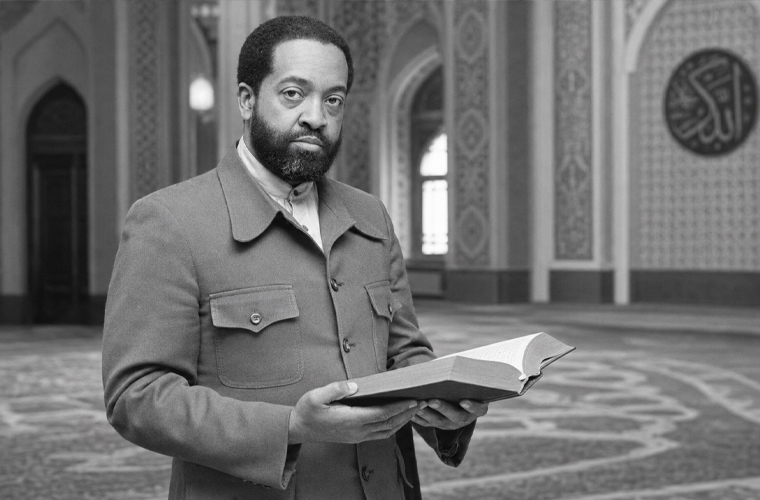
Warith Deen Mohammed (born Wallace Delaney Muhammad, October 30, 1933 – September 9, 2008) was a prominent American religious leader, theologian, philosopher, Muslim revivalist, and Islamic thinker. He is best known for succeeding his father, Elijah Muhammad, as head of the Nation of Islam (NOI) in 1975 and guiding the majority of its members toward orthodox Sunni Islam, fundamentally reshaping African American Muslim life in the United States. Warith Deen Mohammed was born Wallace Delaney Muhammad in Hamtramck, Michigan, to Elijah Poole (later Elijah Muhammad) and Clara Evans Muhammad. He was the seventh of eight children in a family deeply committed to the Nation of Islam, the Black nationalist religious movement founded by Wallace Fard Muhammad in the 1930s.
From childhood, Wallace was viewed as “NOI royalty.” Wallace Fard Muhammad reportedly prophesied his birth and future leadership role. He received intensive religious education within the NOI’s unique theological framework, which blended elements of Islam with Black empowerment, self-reliance, and separatism. In 1958, at age 25, he was appointed minister of Temple No. 12 in Philadelphia, marking his formal entry into leadership.


.
Challenges and Intellectual Development
Personal and ideological struggles marked Mohammed’s path. Registered as a conscientious objector, he refused alternative civilian service at his father’s insistence and was imprisoned in the early 1960s for draft evasion. Prison became a period of deep reflection; he studied the Qur’an, the Bible, and broader religious thought, questioning aspects of NOI doctrine. He experienced multiple excommunications from the NOI (notably in 1969 and 1971) due to theological differences with other leaders, but he rejoined in 1974. These experiences, combined with private study, prepared him for the transformative role he would later play.
Ascension to Leadership and Major Reforms
When Elijah Muhammad died on February 26, 1975, Wallace Muhammad (then known as Wallace D. Muhammad or the Honorable Wallace Muhammad) assumed leadership of the Nation of Islam. Within months, he initiated sweeping reforms to align the organization with mainstream Sunni Islam:
- Rejected the deification of Wallace Fard Muhammad and the prophetic claims made about his father.
- Abandoned racial separatist teachings, including the notion of whites as “blue-eyed devils,” and welcomed people of all races.
- Introduced core Islamic practices: the Five Pillars, daily prayers, fasting, and emphasis on the Qur’an as the primary scripture.
- Promoted the study of Arabic and traditional Islamic scholarship.
- Renamed the organization successively: Bilalians (1975), World Community of al-Islam in the West (1976–1977), American Muslim Mission (1978–1985), and later the American Society of Muslims.
He changed his own name to Warith Deen Mohammed (meaning “Inheritor of the Faith/Religion of Muhammad”) and adopted the title “Imam” instead of Supreme Minister. Physical changes in worship spaces, such as removing pews for traditional floor seating, symbolized the shift. These reforms represented one of the largest mass transitions to Sunni Islam in American history. While a minority followed Louis Farrakhan in reviving the original NOI in 1978, the vast majority remained with Imam Mohammed.
Key Achievements and Public Role
Imam Mohammed’s leadership extended far beyond internal reform. Notable milestones include:
- Leading the largest delegation of American Muslims to perform Hajj in Mecca in 1977.
- Establishing the Committee to Remove All Racial Images of the Divine (CRAID) in 1978 to challenge racial depictions of the divine across faiths.
- Delivering the first Muslim invocation in the U.S. Senate in 1992.
- Reciting from the Qur’an at President Bill Clinton’s inaugural interfaith prayer services (1993 and 1997).
- Addressing the Parliament of the World’s Religions and speaking from the Vatican pulpit at the invitation of Pope John Paul II in 1999.
- Encouraging political participation, economic self-sufficiency, education, and military service among his followers.
He authored over two dozen books and delivered thousands of lectures on topics ranging from Qur’anic interpretation and Islamic philosophy to African American history, social justice, and interfaith dialogue. His teachings emphasized independent reasoning (ijtihad), human excellence, and the compatibility of Islam with American civic life.
Later Years and Legacy
In his later decades, Imam Mohammed continued to guide the community through the American Society of Muslims and related efforts, such as The Mosque Cares. He focused on building institutions, fostering global Muslim ties, and promoting a balanced American Muslim identity. He passed away on September 9, 2008, in Markham, Illinois, at the age of 74 from natural causes. He was survived by multiple children, including his eldest son Imam Warithudeen Mohammed II, who continues aspects of his father’s work.
Imam Warith Deen Mohammed is widely regarded as one of the most important figures in the history of Islam in America. His efforts acquainted hundreds of thousands of African Americans with mainstream Sunni Islam, advanced interfaith understanding, and helped establish a vibrant, indigenous Muslim presence in the United States. His legacy of thoughtful reform, spiritual depth, and universal humanism continues to influence Muslim communities across the country and beyond.
Key Publications include collections such as The Sayings of Imam Warith Deen Mohammed and various works on scriptural interpretation and community development. His life exemplified a profound transition from Black nationalist roots to a universal Islamic vision grounded in scholarship and service.