
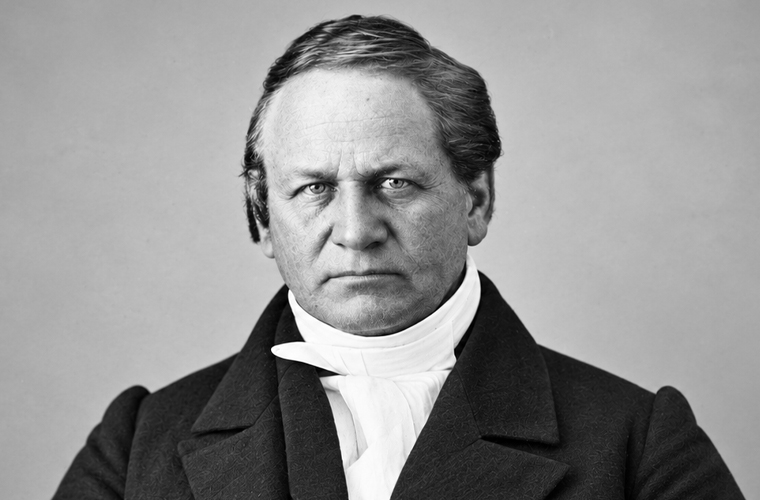
Alexander Lucius Twilight (September 23, 1795 – June 19, 1857) was an American educator, Congregational minister, and politician. He is widely recognized as the first known person of African descent to earn a bachelor’s degree from an American college or university (Middlebury College, 1823) and the first African American elected to a U.S. state legislature (Vermont House of Representatives, 1836). He was also the only African American known to have served in a state legislature before the Civil War.
Early Life and Ancestry
Twilight was born on September 23, 1795, in Corinth (or nearby Bradford), Vermont, the third of six children of Ichabod and Mary Twilight. His parents were free people of mixed African and European ancestry and were recorded as the first “negroes” to settle in Corinth. Ichabod (born around 1765 in Boston) had a Black father and a white (or light-skinned) mother; he served as a private in the Continental Army (Second New Hampshire Regiment) during the Revolutionary War and was described in records as having a “yellow complexion.” Mary was described as white or fair-skinned (possibly of partial African descent). The family appears in the 1800 census under the category “All other free persons except Indians not taxed.”
From about age 8 until he was 21, Twilight worked (likely under an indenture arrangement common for working-class children of the era, including white ones) for a neighboring farmer in Corinth. During those years he taught himself reading, writing, and mathematics while performing farm labor. Around 1815, at age 20, he used savings (possibly with help) to buy out the remaining time of his service and enrolled at Randolph’s Orange County Grammar School. Over the next six years, he completed secondary courses plus the equivalent of the first two years of college-level work.
Education at Middlebury College
In August 1821, at age 26, Twilight entered Middlebury College as a junior. He graduated in 1823 with a Bachelor of Arts degree as one of 18 men in his class (and the oldest at 28). Middlebury later publicized his achievement after Amherst College claimed in 1826 that its graduate Edward Jones was the first African American college graduate. Twilight’s status as the first known person of African descent to receive a baccalaureate from an American institution was not widely recognized during his lifetime; modern awareness grew significantly after research in the 1970s linked him to the 1800 census records. His light complexion meant that contemporaries often did not publicly identify him as Black.
Career as Teacher, Minister, and Builder
After graduation, Twilight taught in Peru, New York (1824–1828). There he continued theological studies, occasionally preached, and was licensed by the Champlain Presbytery of Plattsburgh. On April 20, 1826, he married Mercy Ladd Merrill (c. 1805–1878), a white woman from a family of some means in Unity, New Hampshire; they had no children.
He then taught briefly in Vergennes, Vermont (while holding weekend services in nearby towns), before moving in 1829 to Brownington, Vermont. There he became principal of the Orleans County Grammar School (the only secondary school serving a two-county area) and was ordained as acting pastor of the Brownington Congregational Church. He built a family home that could also board students; it still stands and serves as headquarters for the Orleans County Historical Society.
Enrollment grew rapidly. When trustees would not fully support expansion, Twilight designed, raised funds for, and oversaw construction (1834–1836) of Athenian Hall—a massive four-story granite building measuring about 36 by 66 feet. It was the first granite public building in Vermont and contained a kitchen, dining room, parlor, student dorm rooms, and classrooms (including a large assembly room). Granite came from nearby fields. The co-educational school (roughly one-third female) became known as Brownington Academy. Athenian Hall is now the Old Stone House Museum, centerpiece of the Brownington Village Historic District on the National Register of Historic Places.
Political Service
In 1836, Brownington voters elected Twilight to the Vermont House of Representatives (then the state’s unicameral legislature; the Senate was created that year). He served one term (1836–1837) as a Whig and was the first African American elected to any U.S. state legislature. His main legislative effort was an unsuccessful attempt to prevent the division of grammar-school land-rent funding between Brownington and Craftsbury (which wanted its own school). He argued that one strong school was preferable to two weaker ones.
Later Years, Conflicts, and Return
Twilight continued as principal and (intermittently) pastor. Disputes with school trustees and church deacons—described as involving his “stubborn lack of cooperation”—led him to resign both positions around 1847. He sold Athenian Hall to the trustees and taught for several years in Quebec (Shipton/Richmond and Hatley). Without his leadership, the Brownington school declined and temporarily closed. In 1852, he was persuaded to return as principal (and briefly as pastor). He resigned the pastorate in 1853 but continued leading the school until a major stroke in October 1855 left him partially paralyzed.
Death and Legacy
Twilight died on June 19, 1857, in Brownington and was buried in the Congregational churchyard. Mercy lived until 1878 and is buried beside him. Contemporaries remembered him as a gifted, iron-willed teacher and preacher with a robust sense of humor. Surviving sermon notes show a firm belief in the Bible as divine, progressive history directed by God toward greater individual freedom and conscience, opposition to slavery as incompatible with Christian democracy, and support for temperance. He does not appear to have been active in formal abolitionist organizations.
His legacy includes:
- Recognition as the first known African American college graduate in the United States and the first elected to a state legislature.
- Athenian Hall / Old Stone House Museum and the historic district preserving his home and school.
- Buildings named for him (Alexander Twilight Hall at Middlebury College; auditorium/theater at what is now Northern Vermont University).
- An official portrait in the Vermont State House (unveiled 2022), the first depicting a person of color there.
- September 23 designated as Alexander Twilight Day in Vermont.
- Educational programs and scholarships bearing his name.
Twilight’s life illustrates both remarkable individual achievement in early 19th-century rural New England and the complexities of racial identity in a predominantly white society where a light complexion could allow a person of mixed ancestry to navigate without constant public racial scrutiny. His educational and architectural contributions left a durable physical and institutional mark on Vermont.