
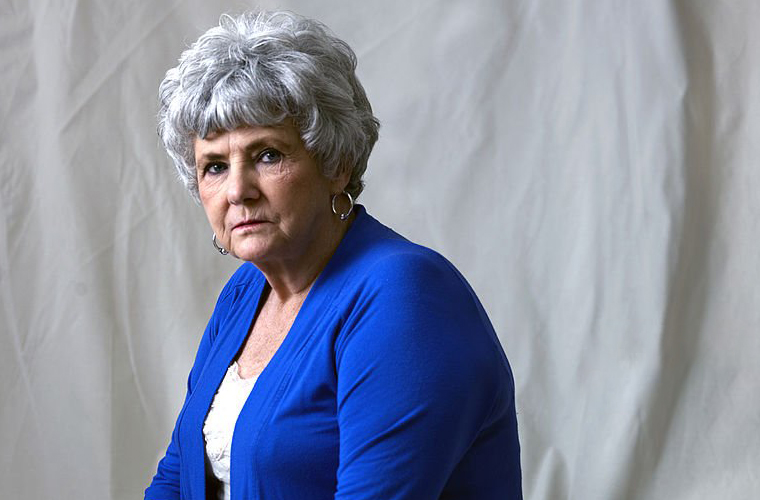
Hazel Bryan Massery (born Hazel Bryan, January 31, 1942) is an American woman best known as the white teenager whose contorted, shouting face appears in the iconic 1957 photograph of Elizabeth Eckford (one of the Little Rock Nine) attempting to enter the newly desegregated Little Rock Central High School. Photojournalist Will Counts captured the image, and it became a defining symbol of white resistance to school integration during the Civil Rights Movement.
Early Life and Family Background
Hazel Bryan was born in Little Rock, Arkansas, into a working-class family shaped by the racial attitudes common in the Jim Crow South. Her father was a disabled World War II veteran who held strong segregationist views (refusing service from Black clerks and avoiding places that employed Black people in visible roles). Her parents had limited formal education—neither completed high school—and the family lived modestly in rented rooms or apartments in poorer neighborhoods. Her mother had married young; the household reflected the economic and social constraints of the era. Sources describe her upbringing as one in which she absorbed the prevailing racial prejudices of her environment, though as a teenager she was more focused on typical interests like dancing and dating than on politics.
The 1957 Little Rock Crisis and the Famous Photograph
On September 4, 1957, nine African American students (the Little Rock Nine) attempted to enter the previously all-white Central High School under a federal court order implementing Brown v. Board of Education. Governor Orval Faubus had deployed the Arkansas National Guard to block them. Elizabeth Eckford arrived alone (due to a communication mix-up) and faced a hostile white mob.
Hazel Bryan, then 15, was among a group of white teenage girls who followed and taunted Eckford, chanting “Two, four, six, eight, we don’t want to integrate!” She was photographed with her face twisted in rage, shouting racial epithets including “Go home, nigger! Go back to Africa!” New York Times reporter Benjamin Fine described her as “screaming, just hysterical.” The photo circulated widely and made her an international symbol of white bigotry and resistance, even though she never actually attended classes with the Little Rock Nine. Her sudden notoriety (including critical mail, mostly from the North) alarmed her parents, who withdrew her from Central High and transferred her to another school. She did not participate in the subsequent harassment of the Black students inside the school that year.
Marriage, Family, and Personal Transformation
Bryan left school at age 16 or 17. In November 1958, she married Antoine Massery (a schoolmate; they married in her church with limited family presence). The couple lived in a trailer on family land in rural east Pulaski County outside Little Rock and later improved their circumstances. Antoine worked in farming and later in antenna and satellite TV installation; the family prospered over time. They had three children (sons Antoine “Tony” and David, and daughter Maria) and, by the late 1990s, several grandchildren. Antoine Massery died on September 3, 2023, at age 83, with Hazel at his side.
In the early 1960s, Massery underwent a significant change in outlook. Exposed to media coverage of the Civil Rights Movement—including Martin Luther King Jr.’s speeches and images of protesters facing violence—she grew reflective and remorseful about her role in the 1957 photo. She realized her own children would one day see “the snarling girl” in history books and identify her as their mother. She left an intolerant church, engaged in social outreach (teaching mothering skills to unmarried Black women and taking underprivileged Black teenagers on field trips), pursued peace activism, and explored feminism and other progressive interests. Her husband sometimes joked that her altruism was a form of atonement. Around 1962–1963, she looked up Elizabeth Eckford in the phone book and called to apologize. Eckford accepted graciously; the conversation was brief. Eckford did not publicly name her at the time.
Later Reconciliation Efforts and Complex Relationship with Eckford
Massery’s private apology remained little known for decades. Public reconciliation came during the 40th anniversary of the Central High desegregation in 1997. Will Counts arranged a meeting between the two women. They posed for a new photograph intended as a symbol of healing, appeared together at events, took a 12-week race-relations course, and developed a friendship. They discussed shared experiences as mothers, shopped together, and spoke about tolerance. Contemporary accounts described them as close; Massery sometimes drove Eckford to events.
The friendship later frayed (by around 2000) over differing perspectives on trauma, responsibility, redemption, and the use of their images (including a “Reconciliation” poster). Eckford, who has spoken of lasting psychological effects from 1957 (including PTSD), felt Massery sometimes sought closure in ways that minimized ongoing pain. Contact became limited, though there were occasional later gestures and a reported thaw after the 2011 publication of David Margolick’s book Elizabeth and Hazel: Two Women of Little Rock. Their story has been widely analyzed as illustrating both the possibility and the difficulties of personal racial reconciliation.
Later Life and Legacy
Massery has generally lived a private life focused on family in the Little Rock area. She has been described as curious and reflective, with interests that evolved far from her teenage views. She is primarily known through the 1957 photograph and the subsequent arc of remorse, apology, and complicated efforts at reconciliation. David Margolick’s Elizabeth and Hazel (Yale University Press, 2011) and numerous articles and documentaries about the Little Rock Crisis chronicle her story in detail. As of the most recent available information (including her husband’s 2023 obituary), she was still living.