
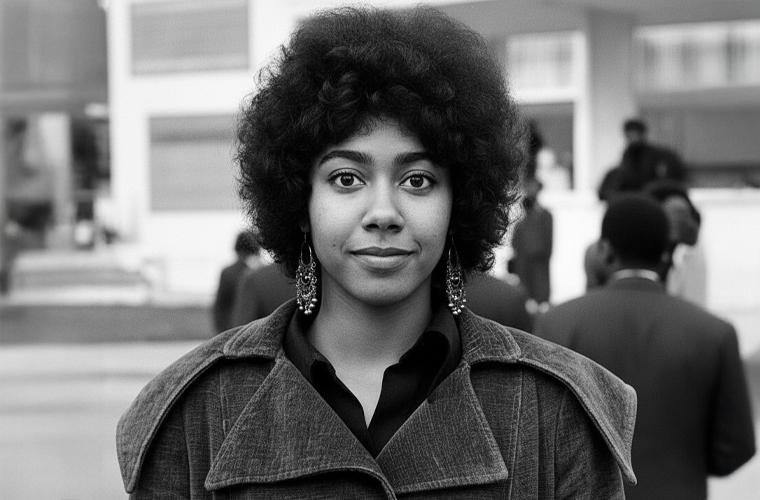
Ericka Huggins (née Jenkins), born January 5, 1948, in Washington, D.C., is a human rights activist, poet, educator, former political prisoner, and leading member of the Black Panther Party (BPP) for 14 years—the longest tenure of any woman in the organization. She has dedicated her life to community service, revolutionary education, restorative justice, spiritual wellness in activism, and equity for marginalized people across lines of race, gender, class, sexuality, and more.
Huggins was the middle child of three in a family where both parents worked as federal clerks. Her political consciousness emerged early. At age 15 in 1963, despite her mother’s concerns for her safety, she attended the March on Washington for Jobs and Freedom. Witnessing the massive gathering of Black people united for justice inspired her to vow to serve humanity for the rest of her life. She later reflected that her mother’s teachings about loving Black people compelled her to act, turning potential disappointment into a foundational commitment.
After graduating from high school in 1966, she attended Cheyney State College (now Cheyney University of Pennsylvania) and then Lincoln University in Pennsylvania, where she studied education. At Lincoln, she met and married John Huggins in 1968, becoming active in student organizations despite resistance to female leadership in the Black Student Congress. She later earned a master’s degree in sociology from California State University, East Bay, with a thesis focused on student-centered, community-based education models to address multigenerational race and gender trauma.


Joining the Black Panther Party
Inspired by an article in Ramparts magazine about Huey P. Newton’s incarceration, Ericka and John Huggins left the university in 1967–1968 and moved to Los Angeles to join the BPP. At age 18 (or around 19–20 in some accounts), she quickly rose as a leader in the Los Angeles chapter alongside her husband. She served as an editor and writer for the Black Panther Intercommunal News Service, contributed to the party’s newspaper, and later joined the Central Committee (1977–1979).
On January 17, 1969—just three weeks after the birth of their daughter, Mai Huggins—John Huggins and BPP leader Alprentice “Bunchy” Carter were assassinated on the UCLA campus by members of the US Organization. The killings were exacerbated by tensions inflamed by the FBI’s COINTELPRO program. At 20 (or 19–21 depending on exact timing), Ericka became a widow and single mother. Devastated, she traveled with her infant daughter to New Haven, Connecticut, for the funeral and, at the invitation of community members and Yale students, helped establish and lead the New Haven chapter of the BPP alongside Kathleen Neal Cleaver and Elaine Brown.
The New Haven Black Panther Trials and Imprisonment
In May 1969, following the torture and murder of BPP member Alex Rackley (suspected of being an informant) by other party members, Ericka Huggins and BPP co-founder Bobby Seale were arrested and charged with murder, kidnapping, and conspiracy in the high-profile New Haven Black Panther trials. A tape recording of Rackley’s interrogation, which included Huggins’s voice, was played in court. Her defense argued she acted under duress. The case drew national attention, with “Free Bobby, Free Ericka” rallies across the country. Huggins spent two years in prison, including time in solitary confinement at Niantic State Farm for Women in Connecticut, while separated from her young daughter (visits were limited to one hour per week).
During this ordeal, she taught herself meditation and yoga as survival tools, drawing on spiritual practices to maintain strength, presence, and well-being for herself and her child. Angela Davis reportedly described her as “the strongest Black woman in America” during this period. In 1971, after the longest jury selection in Connecticut history, the jury deadlocked (10-2 for acquittal in Huggins’s case), and the judge dismissed the charges against her and Seale, citing the impossibility of selecting an unbiased jury. She was released and returned to BPP work.
Leadership in Education and Community Programs
Huggins remained with the BPP until around 1981–1982. From 1973 to 1981, she directed the Oakland Community School (originally the Intercommunal Youth Institute), the party’s longest-running and most successful community program—an innovative elementary school emphasizing holistic, restorative, and liberatory education for Black children. The curriculum she helped develop influenced later models, including aspects of the charter school movement, and focused on whole-child development, critical thinking, and community empowerment. Teachers often worked without pay but received party support for housing and food.
During this time, with community backing, she became the first Black person and first woman appointed to the Alameda County Board of Education, overseeing programs for children with disabilities and incarcerated youth. She also co-authored Insights and Poems (1974) with Huey P. Newton, a collection reflecting on her prison experiences, love, hate, sexism, feminism, spirituality, and liberation.
Post-BPP Activism, Education, and Spiritual Work
After leaving the party, Huggins continued her commitment to service. In the 1980s and beyond, she returned to prisons and jails to teach yoga, meditation, and mindfulness—initially through the Siddha Yoga Prison Project and later in California youth facilities, public schools, community colleges, and foster homes. She volunteered for 15 years in prison projects and five years at the Mind/Body Medical Institute affiliated with Harvard Medical School. In the 1990s, amid the HIV/AIDS crisis, she coordinated practical support at the Shanti Project (as the first woman in that role) and developed programs for women and children of color with HIV/AIDS, as well as support for LGBTQ+ communities in San Francisco and Contra Costa County.
She taught sociology, African American studies, and women’s/gender studies at institutions including San Francisco State University, California State University East Bay, Laney College, and Berkeley City College (2003–2015). For over 30–37 years, she has lectured nationally and internationally at places like Stanford, Cornell, and UCLA on topics including education, spirituality in activism, feminism, prison reform, restorative justice, and the well-being of women, children, and youth. She has facilitated dialogues on racial equity through organizations like World Trust, using films to spark transformative conversations. Her poetry and writings explore personal agency, storytelling as resistance, and intersections of politics and spirit.
A 2025 scholarly biography, Black Panther Woman: The Political and Spiritual Life of Ericka Huggins by Mary Frances Phillips, highlights her as a queer Black woman who integrated spiritual self-care (meditation, yoga) into BPP work and activism, emphasizing wellness amid oppression.
Huggins has three children: daughter Mai Huggins (with John Huggins); son Rasa Sun Mott (born around 1974, with James Mott, lead singer of the BPP’s singing group the Lumpen); and another son, Yadav (born 1987, from a six-year marriage to a Dutch-English man). Since 2006, her partner has been Lisbet Tellefsen, an archivist and collaborator on projects related to BPP history and the Oakland Community School.
She has spoken openly about challenges within the BPP, including allegations of repeated rape by Huey Newton and threats against her children.
Ericka Huggins embodies a blend of revolutionary politics, compassionate education, and spiritual resilience. From her early vow at the March on Washington to her decades of teaching mindfulness as a tool for social change, she has modeled how activism can be sustained through self-care, community, and love. She often emphasizes small daily actions, compassion in dialogue with youth, and the power of listening and serving. Her motto-like reflection: “Love is a great power. Use it to transform your world.” As of the mid-2020s, she continues speaking, mentoring, writing poetry, meditating daily, and facilitating transformative conversations. Her life illustrates the intersections of Black Power, feminism, queer experience, and holistic wellness in the liberation struggle.