
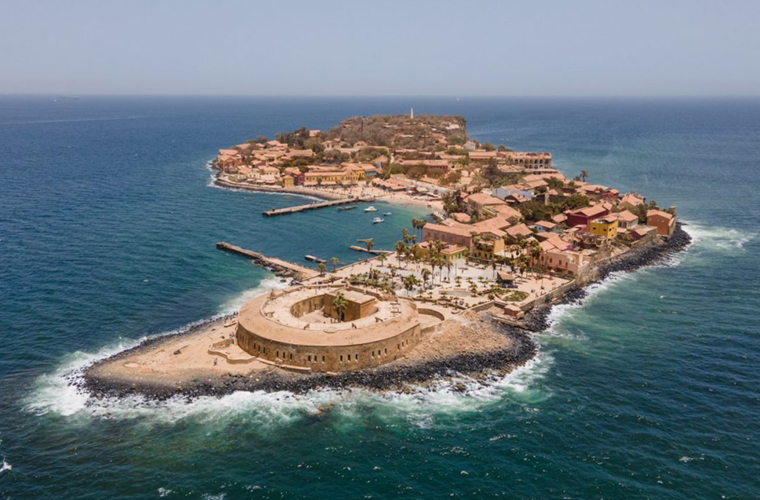
Gorée Island, located near Dakar, Senegal, has a rich historical significance as a critical trading port for Europeans and a major entrepot for slaves taken from West Africa. The island’s history dates back to before European conquest, with accounts of settlement by a population of Wolof fishermen.
in 1444 Portuguese explorers claimed the island, which they renamed Palma Island. Over the centuries, Palma Island became a crucial trade refuge for Portuguese navigators, and ownership changed hands multiple times between European powers such as the Portuguese, Dutch, French, and English. The island’s strategic position in the Atlantic Ocean made it a valuable asset during the transatlantic slave trade era.
Under Dutch ownership in 1588, the island was called Goede Reede, later renamed Gorée. Despite several incursions by the British, Gorée remained a predominantly French trading post after 1677. The island served as a key trading port for various goods, including gold, hides, wax, gum, and ostrich feathers. Additionally, it was a significant transit point for slaves from West Africa who were forced to work on the island before being sent to the Americas.

The famous “Door of No Return” symbolizes the harrowing history of Gorée Island, through which 200 to 400 slaves passed annually from 1677 to 1814. Slavery was permanently abolished on the island in 1848 and was granted equal benefits as a French commune in 1872. However, the decline of the island began in the early 20th century when the capital of French West Africa was moved to Dakar, leading to a migration of islanders to the new capital.
Gorée Island was declared a National History Site by the Senegalese government in 1951 and gained independence from France in 1960 as part of the Republic of Senegal. In the 1970s, efforts were made by the Senegalese government and global organizations to preserve the island’s historical heritage. Today, Gorée Island has less than 1,500 permanent residents and relies mainly on tourism for its survival. Notable museums, including the popular Maison des Esclaves, attract visitors interested in learning about the island’s history and its role in the transatlantic slave trade.
Gorée Island stands as a testament to its complex history and serves as a reminder of the impact of the transatlantic slave trade. Its preservation and status as a National History Site underscore its significance in both Senegalese and global history.