
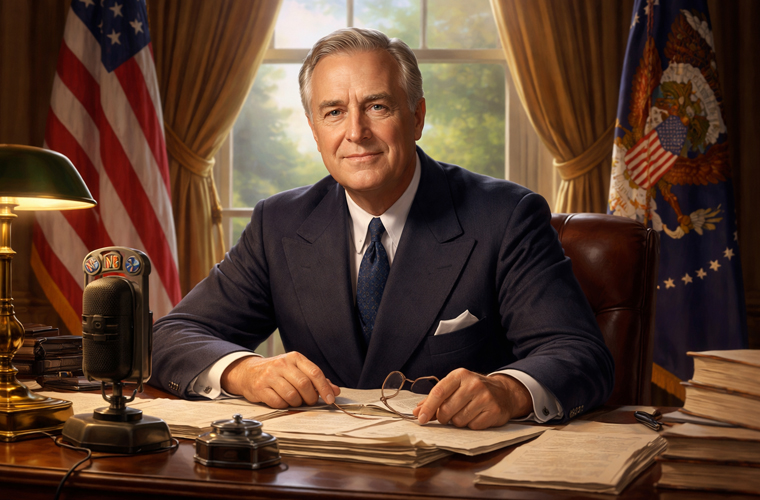
Franklin Delano Roosevelt, often known as FDR, was one of the most transformative figures in American history. As the 32nd President of the United States, he led the nation through the Great Depression and World War II, reshaping the role of government in everyday life and steering the country toward global leadership. Elected to an unprecedented four terms, Roosevelt’s blend of optimism, pragmatism, and bold action earned him both fervent admiration and sharp criticism, but his legacy endures as a symbol of resilience and renewal.
Born on January 30, 1882, in the affluent Hudson Valley estate of Hyde Park, New York, Franklin was the only child of James Roosevelt, a wealthy businessman and widower, and Sara Delano Roosevelt, a strong-willed socialite from a prominent family. Raised in privilege, young Franklin enjoyed a sheltered childhood, tutored at home by private instructors and doted on by his doting mother. His father, 28 years Sara’s senior, instilled a sense of public service, while the family’s Delano lineage connected them to early American elites.
Roosevelt’s formal education began at the elite Groton School in Massachusetts from 1896 to 1900, where he honed his charm and leadership skills amid rigorous academics. He then attended Harvard University, graduating with a Bachelor of Arts in history in 1903 after three years. Ambitious and socially adept, he joined the Porcellian Club and edited the Harvard Crimson. Following Harvard, Roosevelt studied law at Columbia University but left without a degree after passing the bar exam in 1907. He briefly practiced corporate law in New York City for three years before politics beckoned.
On March 17, 1905, Roosevelt married his distant cousin, Anna Eleanor Roosevelt, in a union arranged partly by their families but deepened by shared ideals. Eleanor, niece of Theodore Roosevelt (FDR’s idol and distant relative), brought intellectual depth and social conscience to the marriage. The couple had six children: Anna (1906), James (1907), Franklin (who died in infancy, 1909), Elliott (1910), Franklin Jr. (1914), and John (1916). Though strained by FDR’s infidelities and Eleanor’s growing independence, their partnership became a political powerhouse, with Eleanor evolving into a key advisor and activist.
Politics called in 1910, when, at age 28, Roosevelt was elected to the New York State Senate as a progressive Democrat, championing reforms such as conservation and anti-corruption measures. Reelected in 1912, he caught the eye of national leaders. Supporting Woodrow Wilson’s presidential bid that year, Roosevelt was rewarded with an appointment as Assistant Secretary of the Navy in 1913—a post he held until 1920. There, he oversaw naval expansion during World War I, gaining invaluable experience in administration and foreign affairs. In 1920, he ran as the Democratic vice-presidential nominee alongside James M. Cox, but they lost decisively to Warren G. Harding.
The Trials of Polio and Triumphant Return
Tragedy struck in August 1921 during a family vacation on Campobello Island, Canada. At 39, Roosevelt contracted poliomyelitis, a viral infection that left him paralyzed from the waist down. Confined to a wheelchair (which he concealed in public with braces and canes), he faced not just physical agony but emotional despair, fearing the end of his ambitions. Yet, with Eleanor’s unwavering support and the guidance of loyal aide Louis Howe, FDR refused defeat. He invested in hydrotherapy at Warm Springs, Georgia, founding a rehabilitation center there and later the National Foundation for Infantile Paralysis (precursor to the March of Dimes), which funded polio research and aid.
By 1924, Roosevelt staged a dramatic comeback, delivering a rousing nominating speech for Al Smith at the Democratic National Convention—his leg braces hidden under the podium. This propelled him toward higher office. In 1928, he was elected Governor of New York, succeeding Smith, and reelected in 1930 by a landslide. As governor, FDR tackled the budding Great Depression with innovative relief programs, including state-level public works and unemployment aid, foreshadowing his national agenda.
The Presidency: New Deal and Domestic Revolution
The stock market crash of 1929 plunged America into economic chaos, and by 1932, Roosevelt’s governorship made him the Democratic presidential nominee. Campaigning on promises of “bold, persistent experimentation,” he crushed incumbent Herbert Hoover, winning 57% of the vote. Inaugurated on March 4, 1933, amid bank runs and 25% unemployment, FDR delivered his iconic “The only thing we have to fear is fear itself” address, igniting national hope.
In his first “Hundred Days,” Congress passed 15 landmark bills launching the New Deal—a sweeping array of programs to provide relief, recovery, and reform. He declared a bank holiday to halt panics, established the Federal Deposit Insurance Corporation (FDIC) to insure deposits, and created agencies like the Civilian Conservation Corps (CCC) for youth employment, the Agricultural Adjustment Administration (AAA) to boost farm prices, and the Tennessee Valley Authority (TVA) for rural electrification. Later reforms included the Works Progress Administration (WPA) in 1935, which employed millions in infrastructure and arts projects, and the Social Security Act, offering unemployment insurance, pensions, and aid for the vulnerable.
These measures revived confidence and halved unemployment by 1937, but they ballooned the federal deficit and sparked backlash from conservatives and the Supreme Court, which struck down key laws. FDR’s 1937 “court-packing” plan to add justices failed spectacularly, though the Court soon shifted to uphold New Deal policies. A 1937-38 recession tested his administration, but Roosevelt’s charisma—via “fireside chats” on radio—sustained public faith. He won reelection in 1936 against Alf Landon in a 60-36% landslide, again in 1940 against Wendell Willkie, and in 1944 against Thomas E. Dewey, defying the two-term tradition amid a global crisis.
World War II: Global Leadership
As Europe erupted in 1939, Roosevelt pivoted to foreign policy, overriding isolationists to aid allies through the Lend-Lease Act (1941) and the repeal of neutrality laws. Japan’s December 7, 1941, attack on Pearl Harbor drew the U.S. into war; FDR’s “day of infamy” speech galvanized the nation. As Commander-in-Chief, he forged the “Grand Alliance” with Winston Churchill and Joseph Stalin, signing the United Nations Declaration in 1942. Strategically astute, Roosevelt selected generals like Dwight D. Eisenhower, orchestrated invasions of North Africa (1942), Italy (1943), and Normandy (D-Day, 1944), and planned the atomic bomb.
His vision of postwar peace—via the United Nations and Bretton Woods system—laid the foundations for the modern world order. Yet war’s toll exacerbated his heart disease and hypertension.
Death and Enduring Legacy
On April 12, 1945, just months before Germany’s surrender, Roosevelt suffered a cerebral hemorrhage at Warm Springs and died at 63. Vice President Harry S. Truman assumed office, leading to victory in Europe (VE Day, May 8) and the Pacific (VJ Day, September 2). FDR was buried in Hyde Park’s Rose Garden, mourned by millions.
Roosevelt’s legacy is profound: He modernized the presidency, expanded the government’s safety net, and positioned America as a superpower. Critics decry his expansions of executive power and internment of Japanese Americans, but his leadership through peril—embodied in the New Deal’s equity and WWII’s resolve—remains a beacon. As he said, “The test of our progress is not whether we add more to the abundance of those who have much; it is whether we provide enough for those who have too little.”
Franklin D. Roosevelt’s Approach to Racism and Lynching in the South
Franklin D. Roosevelt’s presidency (1933–1945) coincided with a brutal era of racial violence in the American South, where lynching—extrajudicial mob killings, disproportionately targeting Black men—served as a tool to enforce Jim Crow segregation, suppress Black voting, and maintain white supremacy. Between 1882 and 1968, over 4,700 lynchings occurred, with the majority in the South during the early 20th century. FDR’s record on these issues is often described as ambivalent: he made symbolic gestures and incremental advances influenced by his wife, Eleanor Roosevelt, but prioritized political expediency over bold civil rights action, largely to preserve his New Deal coalition with segregationist Southern Democrats.
The Fight Against Lynching: Eleanor’s Advocacy and FDR’s Caution
Lynchings peaked in the 1930s, with at least 28 documented cases in 1933 alone, often tied to accusations of economic competition or minor infractions against Black individuals. Civil rights groups like the NAACP lobbied fiercely for federal anti-lynching legislation, seeing it as essential to curbing Southern impunity, where local authorities frequently ignored or abetted the violence.
Eleanor Roosevelt emerged as a fierce champion, joining the NAACP in 1934 and collaborating with executive secretary Walter White to revive bills like the Costigan-Wagner Anti-Lynching Bill (introduced in 1934). She arranged a pivotal White House meeting in 1934 where White urged FDR to endorse the measure, which would have made lynching a federal crime punishable by up to 10 years in prison. Eleanor also attended an NAACP exhibition on lynching atrocities, sat silently in the Senate gallery during a 1937 filibuster to show solidarity, and faced severe backlash, including death threats and a $25,000 bounty from the Ku Klux Klan in the 1950s.
FDR, however, refused to back these efforts. In the 1934 meeting, he told White bluntly that supporting the bill “would mean the defeat of every bill we have before Congress,” as Southern Democrats—key to his slim congressional majorities—threatened filibusters that could derail New Deal priorities like Social Security and relief programs. The Costigan-Wagner bill died in a 1935 Senate filibuster led by Southerners, who tied it to blocking FDR’s agenda, including the Social Security Act. A similar fate befell the 1937 Gavagan-Wagner bill, filibustered for weeks by senators like Richard Russell of Georgia. Even during World War II, when lynchings continued (e.g., the 1942 murder of Cleo Wright in Missouri), Southern lawmakers warned they would obstruct war funding unless anti-lynching measures were shelved.
FDR did issue a December 1933 radio address condemning lynching as “murder” and a stain on American democracy, but this was a rhetorical flourish without legislative follow-through. His inaction stemmed from the “Solid South’s” grip on the Democratic Party: FDR won every former Confederate state in his four elections, relying on their votes to pass transformative legislation amid the Great Depression.
Racism in New Deal Programs: Unequal Relief in the South
The New Deal’s relief efforts, while a lifeline for millions, often exacerbated racial disparities in the South, where over half of urban Black residents were unemployed by 1932, and sharecropping systems trapped Black families in debt peonage. Programs were administered locally, allowing Southern officials to embed segregation and discrimination.
- Agricultural Adjustment Administration (AAA, 1933): This paid farmers to reduce production, but white landowners pocketed subsidies without sharing with Black tenant farmers and sharecroppers, who comprised up to 40% of Southern agriculture. Thousands of Black families were evicted from land as a result, deepening poverty.
- Works Progress Administration (WPA) and Public Works Administration (PWA): These employed millions, including Black workers, but in the South, Blacks were relegated to lower-paying jobs (e.g., 20–30% less than whites) and faced quotas limiting their hires to match the local Black population percentage—often under 10%. Segregated facilities were the norm.
Despite these flaws, the New Deal marked a shift: FDR appointed Black leaders like educator Mary McLeod Bethune to advisory roles, forming an informal “Black Cabinet” to advocate for equitable implementation. Interior Secretary Harold Ickes and Eleanor pushed agencies like the Farm Security Administration (FSA) to aid Black farmers more fairly by the late 1930s. Black unemployment dropped from 50% in 1933 to 18% by 1940, partly due to these programs, accelerating the Great Migration of over 1.5 million Blacks from the rural South to Northern cities.
FDR’s personal views evolved under Eleanor’s influence—he hosted Black leaders at the White House and criticized the poll tax that disenfranchised Southern Blacks—but he viewed civil rights as secondary to economic recovery. As he told a Black activist in 1935, “I don’t want to lose five Southern votes in the Senate.”
Wartime Shifts: Executive Action Amid Global Hypocrisy
World War II highlighted the contradictions of American racism: the U.S. fought fascism abroad while tolerating it at home. In 1941, labor leader A. Philip Randolph threatened a march on Washington by 100,000 Black protesters against defense industry discrimination. To avert it, FDR issued Executive Order 8802 on June 18, 1941, banning racial discrimination in federal contracts and creating the Fair Employment Practices Committee (FEPC) to enforce it. This opened over 2 million defense jobs to Blacks, though enforcement was weak in the South, where segregation persisted. Still, Southern resistance remained fierce; the FEPC faced funding cuts and was disbanded in 1946. No anti-lynching law was passed during FDR’s tenure—the Senate didn’t formally apologize for its failures until 2005.
Legacy: Progress Tempered by Compromise
FDR’s dealings with Southern racism and lynching reflect the era’s constraints: his administration provided unprecedented federal aid to Black Americans, laying the groundwork for the civil rights movement by empowering urban Black voters in the Democratic coalition. Yet, his reluctance to challenge Southern Democrats perpetuated Jim Crow, allowing over 200 lynchings during his presidency. Historians debate his culpability—some see a pragmatic leader building a fragile majority, others a president who sacrificed moral imperatives for power. As Eleanor lamented in private correspondence, the fight was far from won, but FDR’s era undeniably shifted the needle, making future advances possible. In his own words from a 1944 campaign speech: “We cannot be a strong nation… unless we are a righteous nation,” a call that, on race, he only partially heeded.