
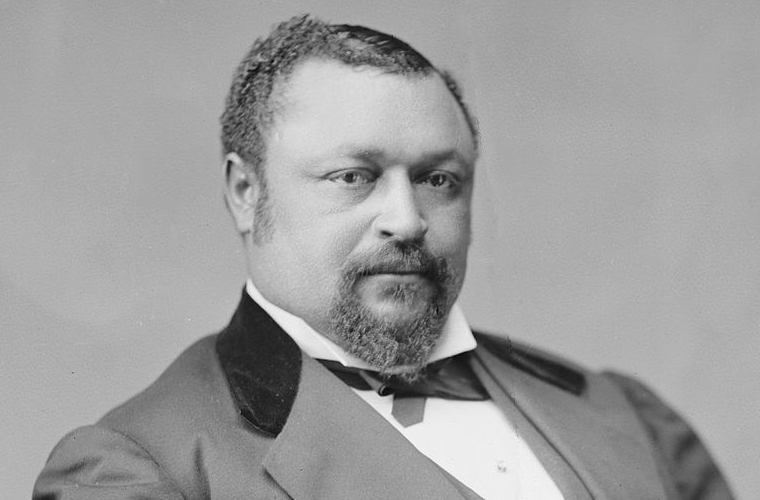
Blanche Kelso Bruce, born on March 1, 1841, in Farmville, Virginia, emerged from the shackles of slavery to become a trailblazing figure in American history. His mother, Polly, was enslaved, and his father was likely Pettus Perkinson, Polly’s master and the son-in-law of her previous owner, Lemuel Bruce. Growing up alongside ten siblings, Bruce experienced the harsh realities of enslavement, working as a servant to his half-brother, William Perkinson. Yet, unlike most enslaved children, he was granted a rare opportunity to learn, receiving instruction from a private tutor that equipped him with the ability to read and write—an advantage that would shape his future.
As the Civil War unfolded, Bruce seized his chance for freedom. In the early 1860s, he escaped to Lawrence, Kansas, where he attempted to enlist in the Union Army but was unsuccessful. By 1864, with the war nearing its end, he settled in Hannibal, Missouri, as a free man. Driven by a passion for education, he established a school for Black children, laying the foundation for his lifelong commitment to uplifting his community through knowledge and opportunity.
Though some accounts suggest Bruce attended Oberlin College in Ohio from 1866 to 1868, no official records confirm this. Regardless, his pursuit of self-improvement continued. By 1868, he had relocated to Mississippi, where he ventured into agriculture, eventually amassing 640 acres for a cotton plantation. This economic foothold marked the beginning of his rise to prominence in a state still grappling with the aftermath of slavery.
Bruce’s entry into politics came in 1870 when the Mississippi Senate appointed him sergeant-at-arms, a role that showcased his leadership and organizational skills. His political ascent accelerated in 1874 when the Mississippi state legislature elected him to the U.S. Senate, making him the second African American to serve in that chamber. Taking office in 1875, Bruce served a full six-year term until 1881, a historic achievement as the first African American to complete a full Senate term. During his tenure, he advocated for significant reforms, including efforts to desegregate the U.S. Army, a bold stance in an era of entrenched racial division. From 1878, he chaired the Select Committee to Investigate the Freedman’s Savings and Trust Company, probing the collapse of an institution meant to support freed African Americans. Additionally, from 1877 to 1879, he led the Select Committee on the Mississippi River, addressing critical infrastructure and economic issues.
Beyond his Senate service, Bruce’s influence extended to national politics. He presided as an officer at the Republican National Conventions of 1880 and 1888, earning vice-presidential nominations at both, though he did not secure the role. His prominence led to key appointments: during President James Garfield’s administration, he served as register of the U.S. Treasury, a position of significant financial responsibility. In 1889, President Benjamin Harrison appointed him recorder of deeds for Washington, D.C., and in 1897, under President William McKinley, Bruce returned to his role as Treasury register.
Bruce’s personal life was equally meaningful. He married Josephine Beall Wilson, a teacher, and together they raised a son, Roscoe Conkling Bruce, who followed in his father’s footsteps as a distinguished educator. Bruce’s life, however, was cut short when he succumbed to diabetes-related complications on March 17, 1898, in Washington, D.C., at the age of 57.
From his early years in bondage to his groundbreaking tenure in the Senate, Blanche K. Bruce’s journey reflects resilience, intellect, and an unwavering commitment to justice and education. His legacy as a pioneer for African American representation in government endures, marking him as a pivotal figure in the fight for equality during Reconstruction and beyond.