
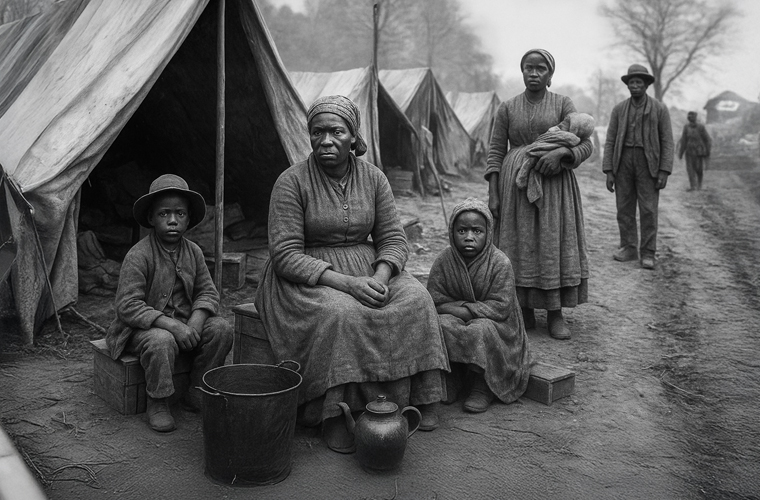
During the American Civil War (1861–1865), contraband camps emerged as significant yet often overlooked havens for enslaved African Americans seeking freedom. These camps, established near Union Army lines, offered refuge to those who escaped slavery, particularly after the Union began recognizing them as “contraband of war” rather than returning them to their enslavers. Life in these camps was a complex mix of newfound freedom, hardship, and resilience, shaping the experiences of thousands as they navigated an uncertain path toward emancipation.
The term “contraband” originated early in the war when enslaved people fled to Union lines, and Union General Benjamin Butler declared them “contraband of war” in 1861 at Fort Monroe, Virginia. This legal workaround allowed the Union to offer protection without immediately addressing the politically charged issue of slavery. As the war progressed, contraband camps sprang up across the South, from Virginia to Louisiana, housing tens of thousands of formerly enslaved people. These camps were often located near military fortifications, in abandoned plantation houses, or makeshift settlements.
Life in contraband camps was marked by both opportunity and adversity. The camps varied widely in size and resources, but most were overcrowded and underfunded. Many residents lived in tents, shanties, or repurposed buildings, with limited access to clean water, food, or medical care. Disease was rampant—smallpox, dysentery, and other illnesses claimed many lives, particularly among children and the elderly. For example, historical records indicate that in some camps, mortality rates reached as high as 25% due to poor sanitation and malnutrition.
Despite these challenges, the camps were places of transformation. Residents, often arriving with little more than the clothes on their backs, worked to build communities. They constructed schools, churches, and mutual aid societies, fostering a sense of collective identity and purpose. Northern missionaries and aid organizations, such as the American Missionary Association, provided some support, supplying teachers and necessities, though resources were often stretched thin.
Work was a central aspect of life in the camps. Many residents labored for the Union Army as cooks, laundresses, or laborers, often for minimal wages or none at all. Others worked on nearby plantations leased by the Union, growing crops like cotton to support the war effort. While this labor provided some economic independence, it also mirrored the exploitation of slavery, as wages were frequently withheld or insufficient. Women, in particular, played a critical role, balancing childcare with work in and outside the camps.
Some camps, like those in the Sea Islands of South Carolina, experimented with land redistribution, allowing formerly enslaved people to farm small plots. These efforts, however, were often short-lived, as land was later returned to former owners after the war, leaving many residents disillusioned.
Education was a cornerstone of contraband camp life. For many, it was their first opportunity to learn to read and write, as literacy had been denied under slavery. Schools, often led by Northern missionaries or educated Black teachers, became hubs of community activity. Adults and children alike attended classes, with some accounts describing people studying by candlelight after long days of work. The desire for education was so strong that, in some camps, residents built their schoolhouses using scavenged materials.
Churches also flourished, serving as spiritual and social centers. They hosted religious services, weddings, and community meetings, reinforcing a sense of agency and hope. These institutions laid the groundwork for Black civic life in the post-war era, fostering leadership and activism.
The camps were diverse, bringing together people from different regions, backgrounds, and experiences of enslavement. This diversity sometimes led to tensions, as residents navigated new social hierarchies and relationships. Women, who often outnumbered men due to the latter’s enlistment in the Union Army, faced unique challenges, including vulnerability to exploitation and the burden of supporting families alone.
Racial dynamics with Union soldiers and Northern aid workers could also be strained. While some Union officers supported the camps, others viewed residents with suspicion or indifference, and instances of abuse were not uncommon. Despite these challenges, camp residents demonstrated remarkable resilience, organizing to advocate for better conditions and asserting their rights as free people.
The contraband camps were a critical stepping stone toward emancipation and Reconstruction. They provided a space where formerly enslaved people could begin to define freedom on their terms, despite systemic obstacles. The skills, networks, and institutions developed in the camps—particularly in education and community organizing—laid the foundation for Black communities in the post-war South.
However, the camps also highlighted the limits of wartime freedom. The lack of long-term support and the eventual rollback of land redistribution efforts underscored the fragility of these early gains. By the war’s end, many residents faced an uncertain future, with some transitioning to sharecropping or migrating to urban areas in search of better opportunities.
Life in contraband camps was a testament to the resilience and determination of those who sought freedom during one of America’s most tumultuous periods. These camps were more than temporary refuges; they were vibrant, if imperfect, communities where formerly enslaved people began to forge new identities as free individuals. Though marked by hardship, the camps represented a pivotal moment in the journey toward equality, leaving a lasting legacy in the fight for justice and self-determination.