
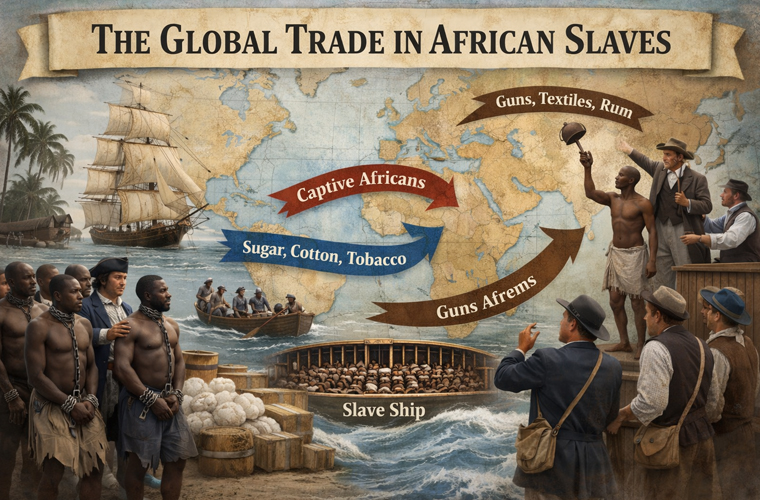
A Brutal Legacy of Exploitation
The trade in African slaves represents one of the most profound and devastating episodes in human history, spanning centuries and continents. From the 7th century onward, millions of Africans were forcibly uprooted from their homelands, subjected to unimaginable horrors, and transported across oceans to fuel the economic ambitions of distant empires. This global commerce in human lives was not confined to the well-known transatlantic routes but encompassed a vast network including the Arab world, the Indian Ocean, and beyond. Over 20 million Africans are estimated to have been enslaved and traded worldwide, leaving indelible scars on societies from Africa to the Americas, the Middle East, and Asia. This article explores the origins, routes, scale, and consequences of this tragic trade, drawing on historical records to illuminate a chapter defined by greed, violence, and resilience.
Slavery in Pre-Colonial Africa
Slavery existed in various forms across Africa long before European involvement, often as a result of warfare, debt, or judicial punishment. Enslaved individuals could integrate into societies, sometimes gaining freedom or status, unlike the chattel slavery that would later dominate global trade. However, the arrival of external demand transformed these systems. Arab traders from the 7th century began purchasing captives along the East African coast, while internal African networks supplied slaves to coastal ports. This pre-existing infrastructure was exploited and expanded by foreign powers, turning local conflicts into engines of mass enslavement.


The Transatlantic Slave Trade: Europe’s Voracious Demand
The transatlantic slave trade, the most documented and infamous branch of this global atrocity, began in earnest in the mid-15th century when Portuguese explorers sailed down West Africa’s coast in search of gold and spices. Initially trading for gold, they soon shifted to human cargo to meet the labor needs of their burgeoning sugar plantations in the Atlantic islands and later the Americas.
By the 16th century, European powers—Portugal, Spain, Britain, France, the Netherlands, and Denmark—had established a triangular trade system. Ships loaded with manufactured goods from Europe docked at West and Central African forts, where enslaved Africans were bartered for. These forts, such as Elmina in modern Ghana, became grim holding pens where captives endured disease, starvation, and abuse before the brutal Middle Passage across the Atlantic. The voyage claimed 10-20% of lives en route due to overcrowding, malnutrition, and “tight-packing” methods designed to maximize profits.
Destinations varied: Brazil received nearly half of the 10-12 million arrivals, followed by the Caribbean (where British ships alone transported 3.4 million between 1640 and 1807) and North America (about 400,000). Enslaved Africans powered the production of sugar, tobacco, cotton, and coffee, generating immense wealth for European economies. The trade peaked in the 18th century, with over 36,000 documented voyages between 1514 and 1866.
| Key Transatlantic Slave Trade Statistics | Value |
|---|---|
| Total Enslaved Transported (1514-1866) | 10-12 million |
| The Brazilian slave tradePrimary European Nations Involved | Portugal/Brazil (46%), Britain (25%), France (10%) |
| Major African Regions of Origin | West Central Africa (Senegambia to Angola) |
| Mortality Rate on the Middle Passage | 10-20% |
.
The Arab and Indian Ocean Slave Trades: An Earlier and Enduring Network
While the transatlantic trade captured much historical attention, the Arab-Muslim slave trade and its Indian Ocean extensions predated it by centuries and persisted longer. Beginning around the 7th century with the rise of Islam, Arab merchants from the Middle East and North Africa raided or purchased slaves from East Africa, Sudan, and the Horn of Africa. Zanzibar emerged as a central hub in the 19th century, where up to 50,000 slaves were auctioned annually, shipped northward across the Red Sea or eastward via dhows to Persia, Arabia, India, and even Southeast Asia.
This trade, often called the “Eastern slave trade,” involved an estimated 17 million Africans over 1,300 years, though numbers are harder to quantify due to sparse records. Slaves were used in households, agriculture, pearl diving, and as concubines or soldiers (eunuchs in harems). Unlike the racialized chattel system of the Americas, enslavement here was not strictly hereditary, but the brutality was no less severe—castration for boys destined for harems was common, with survival rates as low as 10%.
The Indian Ocean trade integrated with monsoon winds, linking Mozambique, Madagascar, and the Swahili coast to Mauritius, Réunion, and beyond. European colonial powers, including the Portuguese and Dutch, participated, blending it with transatlantic patterns. It continued into the early 20th century, outlasting Atlantic abolition by decades.
| Comparison of Major African Slave Trades | Transatlantic | Arab/Indian Ocean |
|---|---|---|
| Time Period | 15th-19th centuries | 7th-20th centuries |
| Estimated Total Enslaved | 10-12 million | 12-17 million |
| Primary Destinations | Americas (Brazil, Caribbean, USA) | Middle East, Arabia, India, islands |
| Main Transport | Ocean-going ships | Dhows and caravans |
.
Routes, Human Cost, and Resistance
The global routes formed a web of suffering: West African captives marched to coastal forts, East Africans herded inland to markets like Bagamoyo. Women and children often faced sexual violence, while men were branded and chained. The total death toll— from capture to final sale—may exceed 20 million, with ripple effects of depopulation and social disruption in Africa.
Yet, enslaved Africans resisted fiercely. Shipboard revolts, like the 1839 Amistad uprising, and maroon communities in the Americas challenged the system. In East Africa, figures like the Yao chief Mlozi organized against Arab slavers.
Abolition and the Long Shadow
Abolition came unevenly. Britain banned the trade in 1807, the U.S. in 1808, and Brazil in 1850, enforced by naval patrols. The Arab trade lingered until the 1962 Saudi ban, though illegal trafficking persisted. Activists like Olaudah Equiano and movements such as the Haitian Revolution (1791-1804) accelerated change.
The legacy endures in racial inequalities, cultural diasporas, and ongoing calls for reparations. UNESCO’s Slave Route Project documents this history to foster remembrance and healing. Understanding the global scope of the African slave trade reminds us that humanity’s darkest impulses were met with an unyielding spirit, shaping the world we inhabit today.