
A Comprehensive History of a Notorious Alexandria Slave Trading Firm
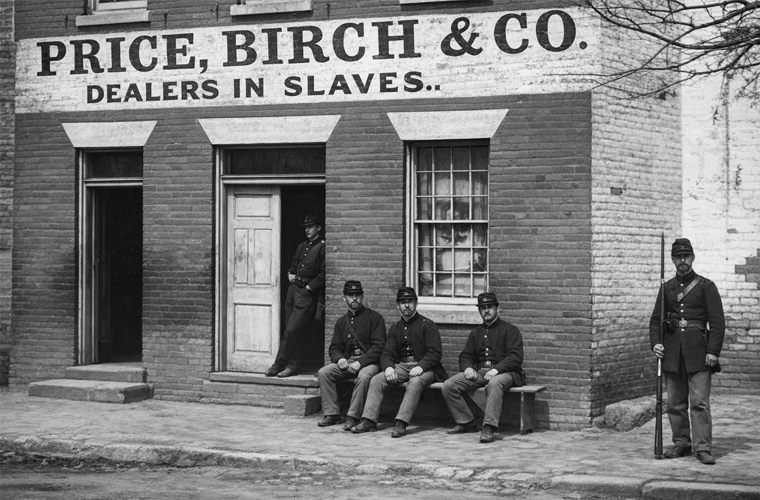
Price, Birch & Co. (sometimes styled Price, Birch and Company) was one of the last major interstate slave-trading firms to operate in the United States before the Civil War. Based at 1315 Duke Street in Alexandria, Virginia (historically numbered 283 Duke Street in some records), the company occupied a site that had served as a central hub for the domestic slave trade for over three decades. Its operations exemplified the brutal efficiency of the antebellum South’s internal slave market, where enslaved people from the Upper South were bought, confined, and shipped to the cotton and sugar plantations of the Deep South. The firm’s name became infamous through surviving photographs taken after Union forces captured Alexandria in 1861, showing the stark sign “Price, Birch & Co., Dealers in Slaves” above the building’s entrance.
The Building and Its Predecessor Firms
The three-story Federal-style brick building at 1315 Duke Street was constructed around 1810–1820 as a private residence for Brigadier General Robert Young. In 1828, it was leased—and later purchased—by Isaac Franklin and John Armfield, who transformed it into the headquarters of the largest slave-trading operation in the United States. Franklin & Armfield shipped thousands of enslaved people annually from Alexandria’s wharves to markets in New Orleans and Natchez, Louisiana/Mississippi, using dedicated packet ships such as the Tribune, Isaac Franklin, and Uncas. The property included extensive slave pens: high brick walls enclosed separate yards for men and women/children, with grated iron doors, cells, a whipping post, and basic provisions to maintain the “merchandise” for auction or shipment. By the 1830s, the firm sold roughly 1,000 people per year.
Armfield sold the property in 1836 (some sources cite 1837 or 1846 for full transfer) to George Kephart, a former agent for Franklin & Armfield who had begun trading slaves as a teenager in Maryland around 1827. Kephart operated the “Negro Jail” as Virginia’s chief slave-dealing firm, continuing the interstate trade and holding up to 300 people at capacity (though typically around 50). He advertised regularly in local newspapers for “likely Negroes” and maintained connections with traders across the region. Kephart owned the site until 1858–1859, when he sold or transferred it while remaining involved as a partner or investor.
Formation and Owners of Price, Birch & Co.
In 1858, the building passed to a new partnership that operated under the name Price, Birch & Co. (or Price, Birch and Company). The firm was founded that year by:
- Charles M. Price (of Montgomery County, Maryland): A principal owner who resided in Maryland and was described as a “rebel” sympathizer. He actively placed newspaper advertisements seeking enslaved people and held nearby property. In 1860, he acquired full title from partner John C. Cook in an internal transfer. Price fled south as Union troops approached Alexandria in May 1861 and sold the property to his brother-in-law Solomon Stover for $6,000.
- John C. Cook (J. C. Cook, of Washington, D.C.): Co-purchaser with Price in 1858; he participated in the trade alongside Price before the 1860 title transfer
- George Kephart (1811–1888) The previous owner and a veteran slave trader. He remained a partner/investor in the firm’s early operations even after selling the building. Kephart came from a Maryland farming family and had extensive experience sourcing enslaved people in the Chesapeake region. After the war, he lived in Baltimore as a farmer and philanthropist (including a donation for a school for Black children), with no public mention of his earlier career in his obituary.
- Birch (William Birch in most contemporary accounts; deeds reference a Henry Birch as a partner in the slave business): The fourth named partner. Little detailed biographical information survives on the Birch partner beyond his association with the firm. Some records link him directly to Price in the slave trade.
The partnership continued the long-established business model at the site, buying enslaved people in Maryland, Virginia, and the District of Columbia and reselling them southward. The firm ceased operations in 1861.
Operations and Conditions in the Slave Pen
Price, Birch & Co. functioned as a holding and auction facility. Enslaved individuals—primarily “likely young negroes” aged 8–25, as advertised by predecessor firms—were confined in the rear pens behind the main office building. Men and women/children were segregated. Facilities included cells, an infirmary to preserve value, a kitchen, and security measures such as iron gates and armed guards. Holding periods ranged from weeks to months before transport by ship or overland coffle. Abolitionist accounts and later Union inspections described dungeons on the ground floor as poorly ventilated “horrible dens” and noted the presence of a whipping post.
The firm profited from regional price differentials: enslaved labor was cheaper in the Upper South (where soil exhaustion reduced demand) and far more valuable in the Deep South’s expanding cotton economy. Like its predecessors, it contributed to the forced migration of hundreds of thousands of people, breaking families and fueling the South’s plantation system.
Civil War Capture and Immediate Aftermath
Alexandria fell to Union forces on May 24, 1861 (some accounts cite May 14 for the initial arrival at the office). The partners had fled, taking most of the enslaved people with them and leaving behind only one elderly man chained to the floor by the leg. Union soldiers discovered the site and repurposed it: it served first as a police office and prison for Confederate soldiers and deserters, then as the L’Ouverture Hospital for Black Union soldiers and housing for “contrabands” (escaped enslaved people). The building’s dungeons were used for military prisoners.
Iconic photographs from 1862–1865 by photographers such as Andrew J. Russell and William Redish Pywell captured the building with its “Price, Birch & Co., Dealers in Slaves” sign still visible, often with Union guards or Black soldiers in the foreground. These images, now held by the Library of Congress and other institutions, became powerful visual evidence of the domestic slave trade.
Post-War History and Legacy
After the war, the outlying slave pens were demolished. The main building was subdivided into apartments and later renovated (including a mansard roof addition around 1905 and a major office conversion in 1984). It passed through private owners before the City of Alexandria acquired it. Today, 1315 Duke Street is the Freedom House Museum, operated by the Northern Virginia Urban League and listed on the National Register of Historic Places as the Franklin and Armfield Office. It interprets the history of the domestic slave trade and honors those who were held there.
The story of Price, Birch & Co. illustrates the final years of a profitable, legally sanctioned industry that treated human beings as commodities. Its partners—Charles M. Price, John C. Cook, George Kephart, and the Birch associate—represented the last generation of professional slave traders in the region before the Civil War, and the 13th Amendment ended the practice. The site remains a tangible reminder of this painful chapter in American history, preserved to educate future generations about the realities of enslavement and the resilience of those who endured it.