
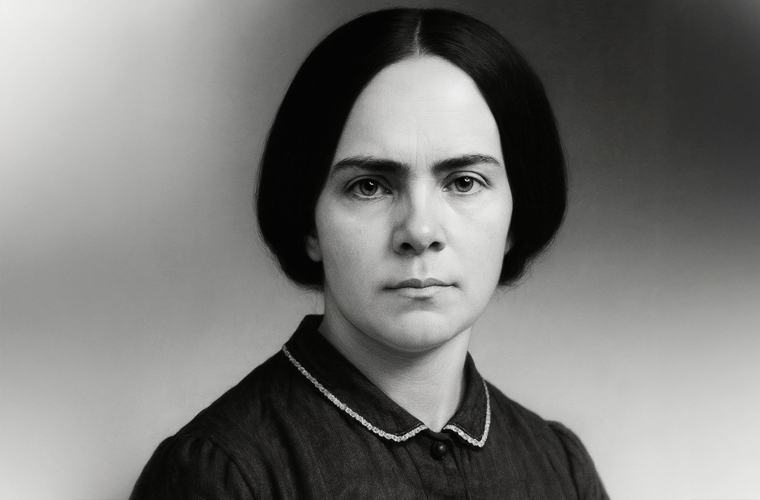
Born on October 9, 1823, in Wilmington, Delaware, Mary Ann Shadd emerged as a pivotal figure in the fight against slavery and for racial and gender equality. As the eldest of thirteen children born to Abraham Doras Shadd, a prosperous shoemaker and veteran of the American Revolutionary War, and Harriett Parnell Shadd, Mary grew up in a household deeply committed to abolitionism. Her father’s activism, including his role as a conductor on the Underground Railroad, profoundly shaped her worldview. The Shadd family, part of the northern free Black elite, prioritized education and social reform, ensuring Mary received a Quaker education, which emphasized intellectual rigor and moral responsibility. This foundation equipped her with the tools to challenge systemic injustices.
Shadd’s early career as a teacher in Delaware, Pennsylvania, and New York provided her with a platform to engage with Black communities and advocate for social change. By the 1840s, she was increasingly disillusioned with the United States’ failure to reconcile its democratic ideals with the institution of slavery. This frustration led her to embrace the Black emigration movement, which sought to establish independent Black communities in regions where slavery had been abolished. Shadd joined a growing number of Black nationalists who viewed emigration as a means of achieving self-determination and escaping racial oppression. Western Canada, particularly what is now southern Ontario, became a focal point for these efforts due to its proximity to the U.S. border and its abolition of slavery under British rule in 1834.
In 1851, Shadd relocated to Windsor, Ontario, driven by a vision of creating autonomous Black settlements free from white control. Canada, under the British monarchy, represented a stark contrast to the United States, offering political and economic opportunities for Black people. Shadd believed that establishing independent Black farming communities was essential to achieving true freedom. She opened a school in Windsor to educate Black children, both fugitive slaves and free-born, but faced significant financial challenges in sustaining it. Despite these struggles, her work as an educator laid the groundwork for her broader activism.
By 1853, Shadd shifted her focus from teaching to journalism, taking over as the primary editor of the Provincial Freeman, a newspaper based in Windsor and later Chatham, Ontario. The Freeman became a vital platform for advocating Black self-reliance, racial equality, and women’s rights. Shadd traveled extensively across Ontario and parts of the United States to promote the newspaper, seeking subscriptions and engaging with Black communities. Her essays, published in the Freeman and other outlets, critiqued the hypocrisy of American democracy and championed the potential for Black prosperity in Canada. Her writings also reflected her progressive views on gender, as she argued for women’s equal participation in public life and leadership roles within the Black community.
In 1856, Shadd married Thomas F. Cary, a Toronto-based barber and businessman, and together they had two children, Sarah and Linton. Following Thomas’s death in 1860, Shadd faced personal and financial hardships but remained committed to her activism. After the U.S. Civil War and the abolition of slavery in 1865, she returned to the United States, settling in Washington, D.C. There, she pursued a law degree at Howard University, becoming one of the first Black women in the United States to earn a legal education. She continued her advocacy for civil rights and women’s suffrage, working alongside figures like Frederick Douglass and Susan B. Anthony.
Mary Ann Shadd Cary’s contributions to abolitionism, Black emigration, and gender equality left an indelible mark on North American history. Her work with the Provincial Freeman amplified Black voices and challenged systemic racism, while her educational and legal pursuits broke barriers for women of color. She died of stomach cancer on June 5, 1893, in Washington, D.C., leaving behind a legacy of resilience and activism. Today, Shadd is remembered as a pioneering journalist, educator, and advocate whose vision for Black self-determination and equality continues to inspire.