
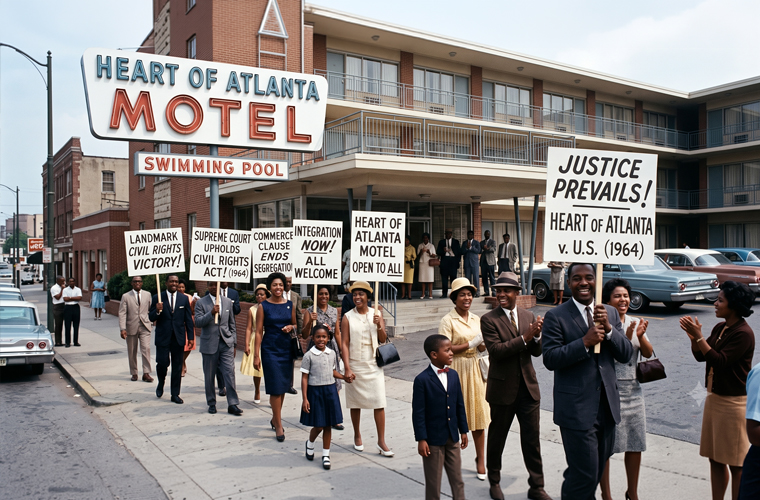
Heart of Atlanta Motel, Inc. v. United States (1964): A Landmark Victory for Civil Rights and the Commerce Clause
In the summer of 1964, President Lyndon B. Johnson signed the Civil Rights Act into law, a sweeping piece of legislation aimed at dismantling systemic racial segregation and discrimination in the United States. Almost immediately, it faced legal challenges. One of the first and most significant was Heart of Atlanta Motel, Inc. v. United States, decided by the U.S. Supreme Court on December 14, 1964. In a unanimous decision, the Court upheld Title II of the Act, which prohibits racial discrimination in public accommodations. This ruling affirmed Congress’s broad authority under the Commerce Clause to regulate private businesses engaged in interstate commerce, marking a pivotal moment in the Civil Rights Movement.
The Civil Rights Act of 1964 was born out of decades of struggle against Jim Crow laws that enforced racial segregation, particularly in the South. African Americans traveling across the country often faced humiliating and dangerous barriers, including denial of lodging, meals, and other services. Congressional hearings documented widespread discrimination in hotels, motels, restaurants, and other public facilities, which severely disrupted interstate travel and commerce.
Title II of the Act specifically targeted “places of public accommodation,” defining them to include hotels, motels, restaurants, theaters, and similar establishments if their operations affected interstate commerce. It declared that all persons are entitled to “full and equal enjoyment” of these facilities without discrimination based on race, color, religion, or national origin.
Facts of the Case
The Heart of Atlanta Motel was a 216-room establishment located in Atlanta, Georgia, near major interstate highways (I-75 and I-85) and U.S. routes. It catered primarily to transient guests, with approximately 75% of its clientele coming from out of state. Despite the new law, the motel—owned by Moreton Rolleston, Jr.—openly refused to rent rooms to Black patrons, continuing a long-standing policy of racial exclusion.
Rolleston filed a declaratory judgment action in federal court, seeking to block enforcement of Title II. He argued that the motel was a local business not directly involved in interstate commerce and that the Act unconstitutionally infringed on his private property rights. The U.S. government counterclaimed, seeking an injunction to force compliance. A three-judge District Court upheld the Act and issued a permanent injunction against the motel. The case quickly reached the Supreme Court.
Key Arguments
The Motel’s Position: Rolleston contended that Congress had exceeded its powers under the Commerce Clause (Article I, Section 8 of the Constitution). He argued that the motel did not engage in “commerce” because it provided services to people rather than goods, and that individuals (not interstate travelers per se) were the direct objects of regulation. Additionally, he claimed the Act violated the Fifth Amendment by depriving him of property without due process and the Thirteenth Amendment by imposing “involuntary servitude” through forced association with Black guests.
The Government’s Position: The United States emphasized extensive evidence from congressional hearings showing that racial discrimination in public accommodations substantially burdened interstate commerce by deterring Black travelers from moving freely across state lines. The government argued that Congress could regulate local activities with a substantial effect on interstate commerce, drawing on precedents like Wickard v. Filburn (1942). It also rejected the constitutional challenges, asserting that the Act addressed a national problem without violating due process or creating servitude.
The Supreme Court Decision
In an opinion authored by Justice Tom C. Clark, the Supreme Court unanimously affirmed the lower court’s ruling. The Court held that Title II was a valid exercise of Congress’s power under the Commerce Clause.
Key points from the opinion:
- The motel clearly affected interstate commerce due to its location, out-of-state clientele, and role in facilitating travel.
- Racial discrimination in such establishments imposed a significant burden on interstate travel, as documented by Congress.
- Congress has the authority to regulate local incidents of commerce that have a substantial relation to the interstate flow of people and goods.
- The Act did not violate the Fifth or Thirteenth Amendments; arguments to the contrary were deemed insubstantial.
Concurring opinions by Justices Hugo Black, William O. Douglas, and Arthur Goldberg reinforced the decision, with some expressing preference for grounding it more firmly in the Fourteenth Amendment’s enforcement powers, though all agreed on the Commerce Clause basis.
Significance and Impact
Heart of Atlanta Motel was one of the earliest and least controversial validations of the Civil Rights Act of 1964. It set a strong precedent for enforcing desegregation in public accommodations and paved the way for broader applications of the Commerce Clause in civil rights legislation. The decision had immediate practical effects, compelling businesses like the Heart of Atlanta Motel to open their doors to all travelers. It underscored that private property rights in the context of public accommodations do not include the right to discriminate in ways that harm national commerce and equality. Together with the companion case Katzenbach v. McClung (involving a restaurant), it helped dismantle key barriers to Black mobility and economic participation.
Longer-term, the case reinforced Congress’s ability to address social issues through its commerce powers, influencing later laws on topics ranging from environmental regulation to healthcare. It remains a cornerstone of constitutional law and civil rights jurisprudence.
Heart of Atlanta Motel, Inc. v. United States stands as a testament to the power of legislative and judicial action to advance equality. By affirming that discrimination in public accommodations burdens interstate commerce, the Supreme Court helped translate the promises of the Civil Rights Act into tangible change. Decades later, its principles continue to shape debates over federal authority, individual rights, and the ongoing pursuit of a more just society.