
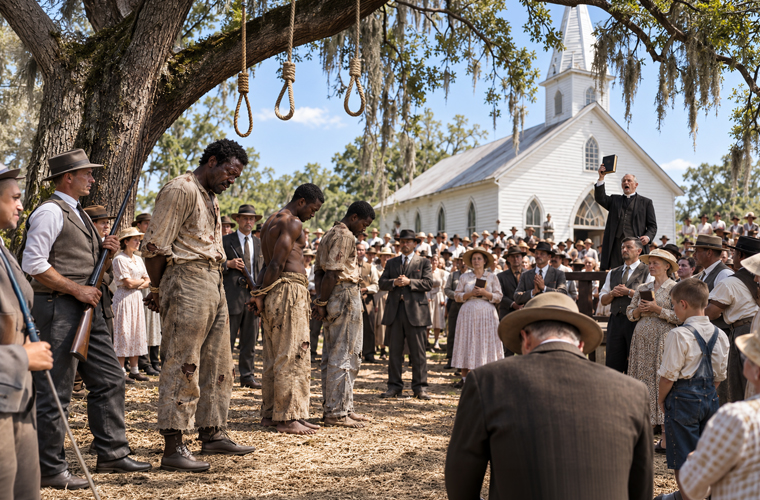
The lynching and torture of Black people in the Jim Crow South were not merely acts of racial hatred or extrajudicial punishment. For many white Southerners, they functioned as religious rituals—communal performances steeped in evangelical Protestant symbolism, ideas of purity and blood sacrifice, and a sacralized defense of white supremacy.
This interpretation draws from historians and sociologists who have examined the cultural, performative, and theological dimensions of the violence. Between 1877 and 1950, white mobs lynched nearly 4,000 Black people across 12 Southern states, according to documentation by the Equal Justice Initiative (a figure higher than some earlier tallies). Many of these were public spectacles involving torture, mutilation, burning, large crowds (sometimes thousands, including women and children), photography, the taking of body-part souvenirs, and post-event celebrations.
The Ritual Character of the Violence
Lynchings often followed patterned scripts rather than spontaneous outbursts. Victims—frequently accused of crimes against white women, real or invented—were seized, sometimes after a manhunt framed as a moral crusade. They were tortured (castration was common in alleged sexual cases), hanged, burned alive, or otherwise killed in ways that prolonged suffering and allowed public participation. Crowds gathered as if for a festival or religious gathering. Photographs and postcards of the events circulated widely. People distributed or sold body parts as relics. Some occurred on Sundays or after church services. Clergymen sometimes participated, incited the mob, or offered theological cover afterward.
Historian Amy Louise Wood, in Lynching and Spectacle: Witnessing Racial Violence in America, 1890–1940, argues that Christianity provided the primary lens through which Southerners understood suffering and death. It was “inconceivable that they could inflict pain and torment on the bodies of black men without imagining that violence as a religious act, laden with Christian symbolism and significance.” The violence enacted and reinforced a sacred social order centered on white purity—especially the sexual purity of white women—and Black subordination.
Theological Underpinnings
Donald G. Mathews, in his influential essay “The Southern Rite of Human Sacrifice” and later work such as At the Altar of Lynching (on the 1899 burning of Sam Hose), framed many communal lynchings as a Southern rite of human sacrifice. In this view, white evangelicalism—emphasizing sin, retributive justice, blood atonement, and a vengeful God—supplied the language and logic. Segregation itself operated as a system of sacred boundaries. The mythic Black rapist (a “demon” or “beast”) threatened the purity of white womanhood and the moral cosmos of the white community. Lynching restored order through blood, expiating the perceived pollution and affirming white virtue and solidarity. Mathews wrote that “Religion permeated communal lynching because the act occurred within the context of a sacred order designed to sustain holiness.” The holiness in question was white racial purity.
Sociologist Orlando Patterson, in Rituals of Blood, went further, estimating that 35–40 percent of lynchings met the criteria of bona fide human sacrifice: torture, mass attendance, and burning. In the aftermath of Confederate defeat, he argued, some white Southerners sought to ritually cast out the “sin” associated with racial mixing or Black presence while retaining Black labor. Fire consecrated the act; body parts functioned like relics; the events reinforced communal bonds and cosmic order. Clergy involvement and Sunday timings added to the sacral atmosphere. Patterson and others noted parallels (and inversions) with Christian imagery of sacrifice and the crucified Christ.
Defenders at the time often described the acts in explicitly religious terms. After one burning, a participant called it “nothing but the vengeance of an outraged God, meted out to him, through the instrumentality of the people.” Newspapers and orators framed mobs as instruments of divine will. The rhetoric of “Christian soldiers” and moral purification was common.
Not Universal, and Contested
Not every lynching fit this mold. Some involved small groups or more pragmatic motives (economic competition, personal grudges, or political intimidation). Public legal executions earlier in the period sometimes featured mixed-race crowds, Black ministers leading prayers and hymns, and the condemned professing faith—dynamics that unsettled white authorities and may have encouraged the shift toward private, white-controlled violence and extralegal lynching.
Black contemporaries frequently rejected the notion that these acts were Christian. NAACP leader Walter White wrote in 1929 that it was “exceedingly doubtful if lynching could exist under any other religion than Christianity,” pointing to the emotional intensity of Southern evangelical preaching. Yet Black ministers and writers often insisted that lynchers stood outside true Christianity, acting as agents of evil rather than faith. Some Black Christians reframed victims as Christ-like martyrs, turning the symbolism against the perpetrators and claiming the authentic Christian inheritance of suffering and redemption.
White Southern Christianity was not monolithic. Some church leaders and denominations condemned lynching as incompatible with the Gospel. The practice declined over time due to anti-lynching campaigns, national publicity of the spectacles (which eventually backfired), economic and demographic changes, and shifting legal norms—not primarily through a sudden theological conversion.
Broader Context and Legacy
These rituals served multiple functions simultaneously: racial terror and social control, enforcement of gender and sexual hierarchies, affirmation of white communal solidarity in a changing (urbanizing, industrializing) South, and the sacralization of a racial caste system. They drew on older traditions of public execution and popular justice while adapting them to post-emancipation white supremacy. The religious dimension does not replace explanations rooted in racism, economics, or politics; it deepens them by showing how ideology, theology, and emotion intertwined.
Understanding lynching as ritual does not claim that Christianity inherently produces such violence—any more than other religions are free of co-option by power. It highlights how a particular historical form of Southern evangelicalism, fused with white supremacy, supplied symbols, justifications, and emotional intensity that made extreme public cruelty feel righteous and restorative to participants. The same tradition contained resources for critique and resistance, as Black Christians demonstrated.
The record is one of profound moral failure: a society that baptized racial domination in the language of holiness and purity. Confronting that history requires acknowledging both the racial and the religious elements without reducing one to the other. The spectacles were acts of racism and performances of a distorted sacred order.