
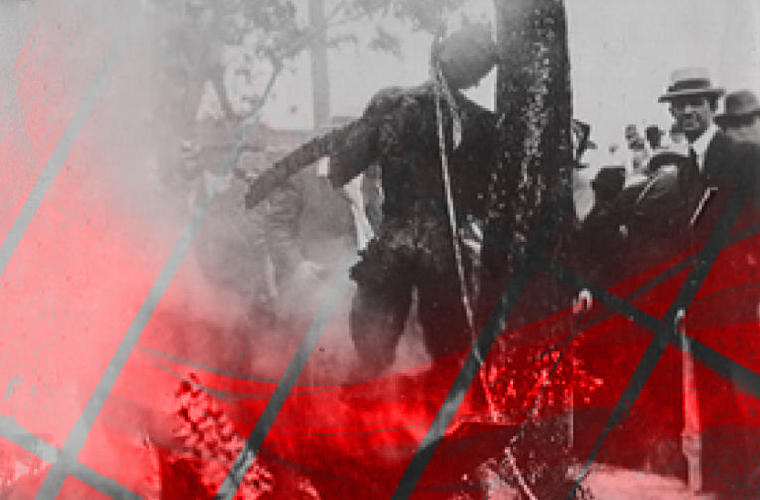
On May 15, 1916, in Waco, Texas, a 17-year-old African American farmhand named Jesse Washington was brutally lynched by a white mob in front of an estimated crowd of 10,000 to 15,000 spectators. The event, often called the “Waco Horror,” stands as one of the most infamous and well-documented lynchings in American history due to its public spectacle, the involvement of local authorities who failed to intervene, and the graphic photographs taken during the atrocity. Washington had been hastily convicted earlier that day of the rape and murder of Lucy Fryer, a white woman for whom he worked. What followed was not a swift execution but a prolonged torture and burning that shocked the nation and became a pivotal moment in the NAACP’s anti-lynching campaign.
This lynching occurred amid a broader epidemic of racial violence in the post-Reconstruction South, where lynchings served as tools of terror to enforce white supremacy. Between 1882 and 1930, Texas recorded 492 lynchings, many targeting Black men accused of crimes against whites.
Background and Context
Waco in 1916 was a prosperous city of over 30,000 residents, promoting itself as a pious, idyllic community with a growing Black middle class and institutions like two Black colleges. However, beneath this veneer lay significant racial tensions. Local newspapers frequently highlighted crimes by African Americans, and a prior lynching (of Sank Majors in 1905) underscored the city’s history of mob violence. The 1915 film The Birth of a Nation, which glorified the Ku Klux Klan, and other incidents heightened racial animosities. Jesse Washington, born around 1898 or 1899, was the eldest of 12 children in a family that had recently moved to the area. Described as illiterate, quiet, and possibly intellectually disabled, he had worked for about five months on the Fryer farm in Robinson, a small community about seven miles south of Waco.
The Murder of Lucy Fryer and Arrest
On the morning of May 8, 1916, 53-year-old Lucy Fryer (an English immigrant and respected farmer’s wife) was found bludgeoned to death in the doorway of her farm’s seed shed. Evidence suggested blunt-force trauma (likely a hammer) and possible signs of sexual assault, though later examinations questioned the latter. Suspicion quickly fell on Jesse Washington, who was found with blood-stained overalls (which he attributed to a nosebleed). He and family members were taken for questioning. Washington was held without an attorney or parents present and gave inconsistent statements. To protect him from immediate mob violence, authorities moved him to jails in Hill County and then Dallas. Under interrogation and promises of protection, he eventually confessed to the rape and murder, signing with an “X” as he was illiterate. This coerced confession was widely published in local newspapers before the trial. A grand jury indicted him on May 11, and the trial was set for May 15.
The Trial
The McLennan County Courthouse filled rapidly on the morning of May 15. The all-white jury was selected quickly, with inexperienced defense attorneys offering little resistance or preparation. Testimony focused on the confession and basic evidence; the doctor who examined Fryer did not confirm rape. Washington reportedly muttered responses interpreted as a guilty plea and later said, “That’s what I done.” The jury deliberated for just four minutes before returning a guilty verdict and death sentence. The entire trial lasted about an hour. Before officials could remove Washington, a mob surged forward and seized him.


.
The Lynching
The mob dragged Washington from the courthouse, chaining him by the neck. As they paraded him toward City Hall, he was beaten, stabbed, and mutilated—his fingers, toes, and genitals were cut off. A bonfire of dry-goods boxes and wood had been prepared. Washington was doused with coal oil (kerosene), hanged from a tree, and repeatedly lowered and raised into the flames for about two hours to prolong his suffering. He reportedly tried to climb the chain but could not due to his injuries.
Spectators, including children (some on lunch break from school), cheered. Local officials like Mayor John Dollins and Police Chief Guy McNamara were present but did not intervene. Sheriff Samuel Fleming had instructed deputies not to stop the mob. Professional photographer Fred Gildersleeve, possibly alerted in advance, documented the event from City Hall, capturing images of the crowd and the torture in progress—rare for lynching photography, which usually showed only aftermaths. After the fire died, Washington’s charred remains were dragged through town, displayed publicly in Robinson, and later buried. Souvenirs like bones, teeth, and chain links were taken and sold.
Immediate Aftermath and Local Response
No one was arrested or prosecuted for the lynching, despite it being illegal. Some local voices, including the jury foreman and Baylor University faculty, criticized the failure to protect Washington. Texas newspapers offered mixed reactions—some expressed regret but resented national criticism—while major Northern outlets like the New York Times condemned it. Gildersleeve sold postcards of the photos, which circulated widely before officials asked him to stop.
NAACP Investigation and National Impact
The NAACP, then a young organization, hired investigator Elisabeth Freeman (a women’s suffrage activist) to probe the event. Despite local reluctance, she gathered details, interviewed residents, and acquired Gildersleeve’s photos. She concluded Washington had murdered Fryer, but that rape allegations were likely false, and the white community largely supported the lynching.
W.E.B. Du Bois published a special supplement to The Crisis magazine in July 1916 titled “The Waco Horror,” featuring the gruesome images and details. Distributed to subscribers, newspapers, and Congress, it boosted the NAACP’s anti-lynching efforts, growing circulation and raising funds. The photos turned the mob’s own documentation against them, helping shift public opinion and contributing to a decline in open support for such spectacles.
Long-Term Legacy
The Waco Horror highlighted the barbarity of lynching and aided the push for federal anti-lynching legislation (though it faced delays and failures). In Waco, the event was largely suppressed in local memory for decades. In the 1990s–2000s, efforts for a monument faced resistance, but on the 2016 centennial, Mayor Malcolm Duncan held a ceremony apologizing to Washington’s family and the Black community. A historical marker now commemorates the site.
Patricia Bernstein’s book The First Waco Horror (2005) provides a detailed account, and the event has been referenced in cultural works, including the film BlacKkKlansman.
Historical Significance
The lynching of Jesse Washington exemplifies the intersection of racial terror, flawed justice, and spectacle in the Jim Crow era. It exposed how local institutions could enable mob rule and how visual evidence could be weaponized for reform. While not erasing the tragedy, the NAACP’s response marked a step toward greater national awareness and the long struggle for civil rights. Today, it serves as a somber reminder of the costs of unchecked racism and the importance of historical reckoning.