
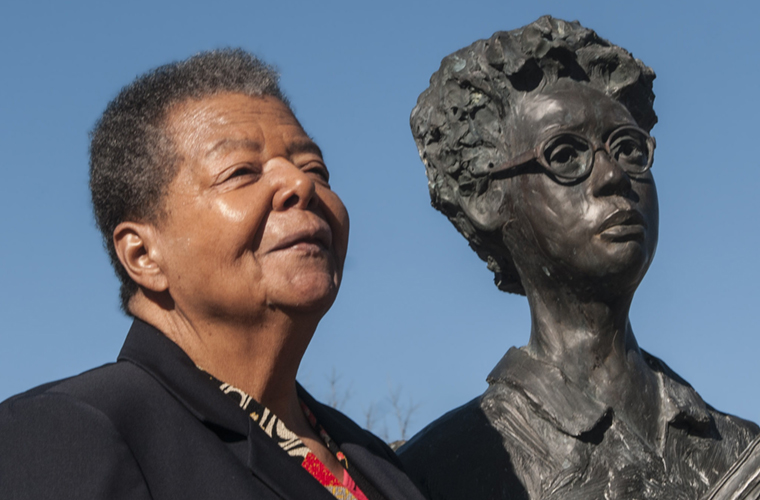
Elizabeth Ann Eckford (born October 4, 1941) is an American civil rights activist best known as one of the Little Rock Nine, the group of African American students who desegregated Little Rock Central High School in Arkansas in 1957. The iconic photograph of the 15-year-old Eckford walking alone through a jeering white mob on September 4, 1957—taken by Will Counts—became one of the most powerful and widely circulated images of the Civil Rights Movement, drawing national and international attention to the crisis.
Early Life and Family
Eckford was born in Little Rock, Arkansas, to Oscar and Birdie Eckford and is one of six children. Her father worked nights as a dining car maintenance worker for the Missouri Pacific Railroad’s Little Rock station (and also cleaned houses on weekends). Her mother taught laundry skills at the segregated state school for blind and deaf children. The family lived modestly in a small brick house and did not have a telephone, a fact that would prove significant in 1957. She attended the all-Black Horace Mann High School, where she was a quiet, studious student who loved history and aspired to become a lawyer (inspired by figures such as Thurgood Marshall). In the spring of 1957, she volunteered to help desegregate Central High after careful consideration, despite her mother’s initial reluctance.
The Little Rock Crisis (1957–1958)
Following the 1954 Brown v. Board of Education Supreme Court decision declaring segregated public schools unconstitutional, the Little Rock school board planned limited desegregation. Arkansas Governor Orval Faubus deployed the Arkansas National Guard to block the Black students’ entry, claiming he was preserving order. On September 4, 1957, the nine students were supposed to arrive together under the guidance of NAACP leader Daisy Bates. Because the Eckford family had no phone, Elizabeth was not informed of a last-minute change in plans. She took a city bus alone, arriving first and walking toward the school in a homemade black-and-white dress, sunglasses, and carrying her books. National Guardsmen barred her entry while allowing white students through. She was then confronted by a hostile mob of hundreds that shouted threats (including calls to lynch her), spat at her, and pursued her as she walked to a bus stop. A white reporter (Benjamin Fine) and later a white woman (Grace Lorch) helped protect her until she could board a bus to her mother’s workplace.


.
After weeks of legal and political standoffs, President Dwight D. Eisenhower federalized the Arkansas National Guard and sent the 101st Airborne Division to enforce the court order. On September 25, 1957, the Little Rock Nine entered the school under military escort. They faced relentless harassment, violence, and isolation inside the school throughout the year. Eckford and the others endured daily taunts, physical attacks, and psychological pressure. Governor Faubus closed all Little Rock public high schools for the 1958–1959 school year to prevent further integration. Eckford did not graduate from Central High but completed enough credits through correspondence and night courses to earn her diploma (she later obtained a GED after moving temporarily to St. Louis).
Education, Military Service, and Career
Eckford was accepted to Knox College in Illinois but returned to Little Rock to be closer to her family. She later earned a B.A. in history from Central State University in Wilberforce, Ohio. In 2018, Knox College awarded her an honorary doctorate. She served five years in the U.S. Army, first as a pay clerk and later (after reenlisting) as an information specialist, writing for base newspapers at Fort McClellan (Alabama) and Fort Benjamin Harrison (Indiana). After leaving the military, she held a variety of jobs, including waitress, history teacher, welfare worker, unemployment/employment interviewer, military reporter, and (for many years) probation officer in Little Rock.
Personal Struggles and Later Life
The trauma of 1957 had lasting effects. Eckford has spoken openly about struggling with depression and post-traumatic stress disorder (PTSD). She attempted suicide at least twice. In 2003, one of her two sons, Erin Eckford (age 26), who had mental health issues and was off his medication, was fatally shot by Little Rock police after firing a rifle; prosecutors later ruled the shooting justified. Eckford has described fearing it may have been “suicide by police.”
She has generally maintained a lower public profile than some other members of the Little Rock Nine, though she has participated in commemorations and speaking engagements. In 1997, she and Hazel Bryan Massery (the white teenager famously photographed screaming at her) briefly reconciled, shared the Father Joseph Biltz Award, and appeared together publicly; the friendship later ended.
In 2018, she co-authored a book for young readers, The Worst First Day: Bullied While Desegregating Central High (with Dr. Eurydice Stanley and Grace Stanley, illustrated by Rachel Gibson). That same year, a commemorative bench was dedicated in her honor near the school, and she received the Community Truth Teller Award. She has continued public speaking into her 80s, including international trips (such as teaching civil rights history in New Zealand in 2019) and participating in the 2022 keel-laying ceremony for the submarine USS Arkansas. In 2024, she was honored as a Living Legend by the Military Women’s Memorial.
Awards and Legacy
- Spingarn Medal (NAACP, 1958, with the other Little Rock Nine members and Daisy Bates)
- Congressional Gold Medal (1999, presented by President Bill Clinton)
- Father Joseph Biltz Award (1997, shared with Hazel Bryan Massery)
- Other recognitions for her role in the civil rights struggle
Eckford’s solitary walk into the mob on September 4, 1957, remains one of the defining visual symbols of the fight against school segregation. She has emphasized that ordinary people can act with extraordinary courage under pressure and has used her experiences to advocate for treating others with humanity and supporting those under attack. As of the mid-2020s, she continues to reside in the Little Rock area and remains a living link to a pivotal chapter in American civil rights history.